
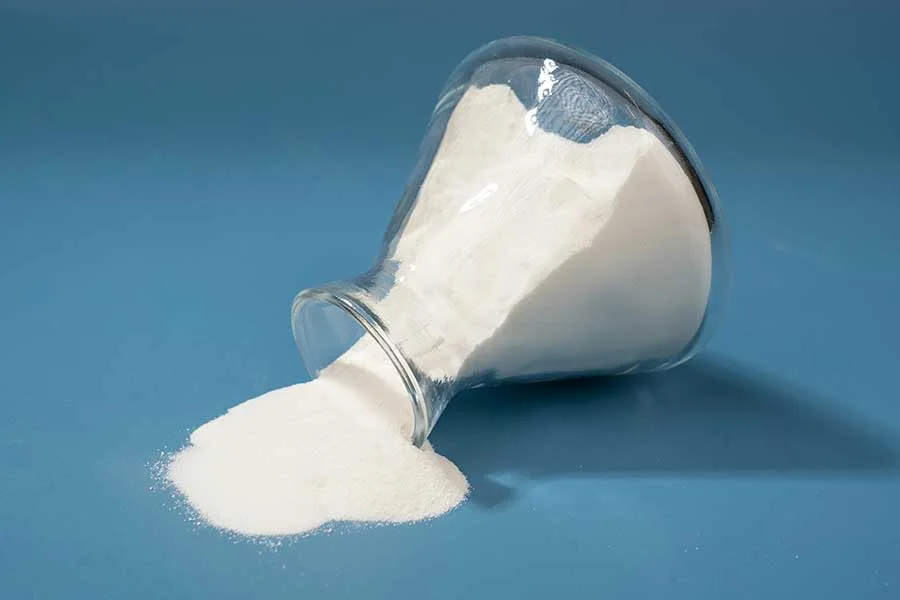
Redispersible Polymer Powder — commonly abbreviated as RDP or VAE powder — is a free-flowing white powder manufactured by spray-drying a Vinyl Acetate-Ethylene (VAE) copolymer emulsion. When blended into a dry mix mortar formulation and re-wetted on the job site, the powder re-disperses into a stable polymer film that binds cement particles together and coats aggregate surfaces.
The result? A mortar that is simultaneously strong, flexible, and water-resistant — three properties that are notoriously difficult to achieve together in cement-based systems.
Key specifications to know:
| Property | Typical Range |
|---|---|
| Ash content (at 600°C) | 10–14% |
| Bulk density | 400–550 g/L |
| Particle size (D50) | 80–120 μm |
| Minimum film-forming temperature (MFFT) | 0–5°C |
| Glass transition temperature (Tg) | -10°C to +5°C |
Standard Portland cement mortar creates adhesion primarily through mechanical interlocking. RDP adds a second bonding mechanism: polymer bridging. The re-dispersed polymer chains physically connect the tile backing with the substrate, dramatically increasing pull-off strength.
Industry data consistently shows that a tile adhesive with 1.5–2.5% RDP (by weight of dry mix) achieves pull-off strengths of ≥0.5 MPa (meeting EN 12004 Class C2 requirements) compared to ≤0.3 MPa for plain cement mortars.
This matters especially when tiling over:
Tile installations are stressed by thermal expansion, structural settlement, and substrate movement. Rigid cement mortars crack and delaminate under these forces. RDP-modified adhesives absorb stress without fracturing.
The polymer network acts as a micro-reinforcement, distributing tensile stress across millions of polymer chains rather than concentrating it at weak points. This is why C2 class tile adhesives (which are required in many GCC and European building codes) mandate polymer modification.
In Saudi Arabia and UAE, where daily temperature swings of 25–35°C are common on building facades, RDP-enhanced adhesive is not optional — it’s the only code-compliant choice.
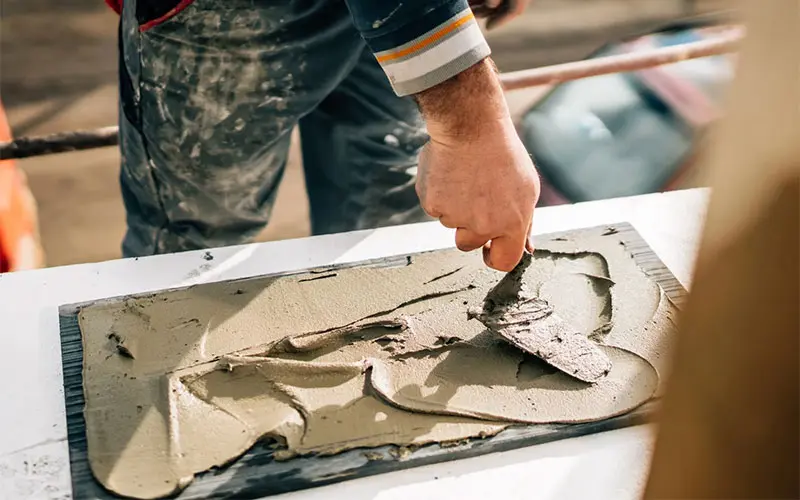
Construction crews in hot climates face a brutal challenge: standard cement mortars dry out in minutes when ambient temperatures exceed 35°C. RDP fundamentally changes the hydration kinetics by:
A well-formulated RDP tile adhesive can maintain open time of 20–30 minutes even at 40°C — a critical advantage for large-tile installations in Middle Eastern projects.
Polymer-modified adhesives are required in wet areas: bathrooms, swimming pools, commercial kitchens, and building facades. RDP forms a hydrophobic polymer film that:
Higher RDP content (2.5–4%) is typically specified for Class D (underwater) and Class W (wet area) tile adhesive systems.
A standard C2TE tile adhesive (improved, extended open time) formulation might look like this:
| Component | % by Weight | Function |
|---|---|---|
| Ordinary Portland Cement (OPC 42.5) | 25–35% | Hydraulic binder |
| Graded quartz sand (0.1–0.6 mm) | 55–65% | Aggregate |
| RDP (VAE, Tg ~0°C) | 1.5–2.5% | Flexibility, bond strength |
| HPMC (hydroxypropyl methylcellulose) | 0.2–0.4% | Water retention, anti-sag |
| Retarder (citric acid, tartaric acid) | 0.05–0.1% | Open time extension |
| Hydrophobic agent | 0–0.3% | Water resistance |
Formulation tip: The synergy between RDP and HPMC is critical. HPMC controls early-stage water retention and consistency, while RDP builds long-term flexibility and bond strength. Do not substitute one for the other.
Not all RDP is equal. The critical selection parameters are:
1. Glass Transition Temperature (Tg)
2. Protective Colloid System
3. Ash Content Lower ash content indicates higher polymer content. When comparing suppliers, ash content is a more reliable indicator of true polymer loading than price alone.
4. Re-dispersibility Request the re-dispersibility test (FANN test or equivalent): a quality RDP should form a stable, particle-free dispersion within 2–3 minutes of mixing with water.
The RDP market is unfortunately flooded with low-quality products that meet minimum paper specifications but fail in the field. Tenabrix’s experience supporting customers from India to Saudi Arabia has identified several red flags:
 Warning signs of poor-quality RDP:
 What Tenabrix RDP guarantees:
The global tile adhesive market is projected to reach USD 5.8 billion by 2028 (CAGR 6.4%), driven by:
For dry mix mortar manufacturers in these markets, RDP quality directly determines whether their adhesive products can command premium pricing and pass increasingly stringent third-party certifications.
Q: What is the difference between RDP and latex in mortar? RDP is the dry, redispersible form of polymer latex. Both achieve similar performance outcomes, but RDP enables factory-made dry mix mortars with extended shelf life, while liquid latex must be added on-site and has a much shorter shelf life.
Q: Can I use less RDP and compensate with more HPMC? No. HPMC and RDP perform entirely different functions. Increasing HPMC dosage will improve water retention and consistency but will NOT improve bond strength or flexibility — it may even reduce strength at high dosages.
Q: What is the minimum effective RDP dosage in tile adhesive? For C1 class adhesive (standard), 1.0–1.5% is the practical minimum. For C2 class (improved), 1.5–2.5%. Below 1.0%, polymer modification effects are marginal.
Q: How should RDP be stored? Store in original sealed bags, in a dry warehouse away from direct sunlight. Do not stack more than 20 bags high. Avoid temperatures above 40°C for extended periods. Shelf life: 12 months from production date.
Redispersible Polymer Powder is not a commodity — it is the performance engine of modern tile adhesive systems. The difference between a C1 and C2 adhesive, between a product that passes EN 12004 and one that fails, and between a facade tile installation that lasts 20 years and one that delamminates in 3 years, often comes down to RDP quality and dosage.
If you are a dry mix mortar manufacturer looking for a reliable RDP supplier with consistent quality, competitive pricing, and genuine technical support, Tenabrix is ready to be your partner.
 Request a free sample or technical data sheet — our technical team will help you optimize your formulation for your specific market.
Michem Chemical Co., Ltd., supplying high-quality RDP/VAE, HPMC, cellulose ethers, PP fiber, and admixtures to construction material manufacturers worldwide. Visit michemicals.com for the full product range.