PAN Fiber Three Types Selection Guide: High-Modulus vs Alkali-Resistant vs Short-Cut for Concrete

Michem PAN 12mm fiber

Introduction

Michem PAN fiber offers three specialized types engineered for distinctly different concrete application scenarios, eliminating the compromise of one-size-fits-all solutions.

Table of Contents

High-Modulus PAN Fiber (tensile ≥800 MPa, modulus ≥4000 MPa) is the premier choice for heavy-load infrastructure — bridges, tunnels, and industrial floors — where maximum crack restraint is non-negotiable. Its modulus approaches early-age cement stiffness, engaging immediately as the matrix shrinks and intercepting micro-cracks before they propagate.

Alkali-Resistant PAN Fiber (tensile ≥750 MPa, proprietary surface coating) is purpose-built for aggressive chemical environments: marine splash zones, chemical containment, and tunnels exposed to de-icing salts. The coating forms a chemically inert barrier preserving fiber integrity in high-pH concrete (pH 12.5–13.5) — environments where uncoated fibers degrade within 5–10 years.

Short-Cut PAN Fiber (tensile ≥700 MPa, available in 3 mm and 6 mm) is optimized for process-critical applications — shotcrete lining, precast panels, and rapid-mix operations. The shorter aspect ratio ensures rapid, balling-free dispersion in high-speed mixing and pneumatic application, prioritizing workability and throughput.

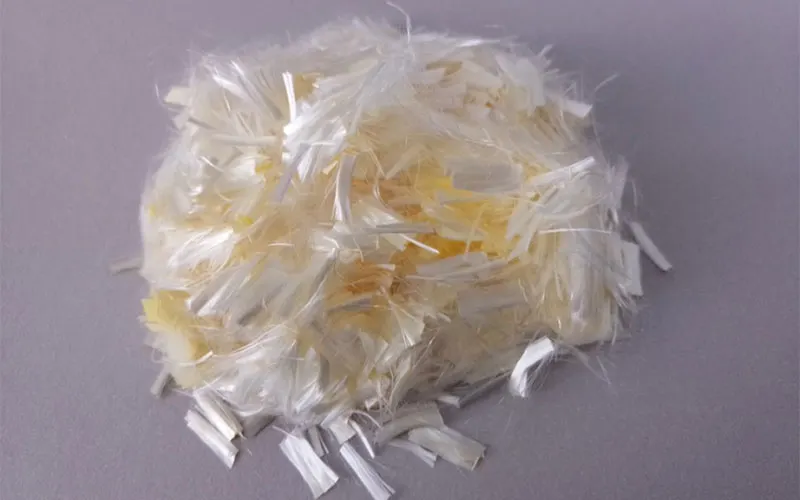
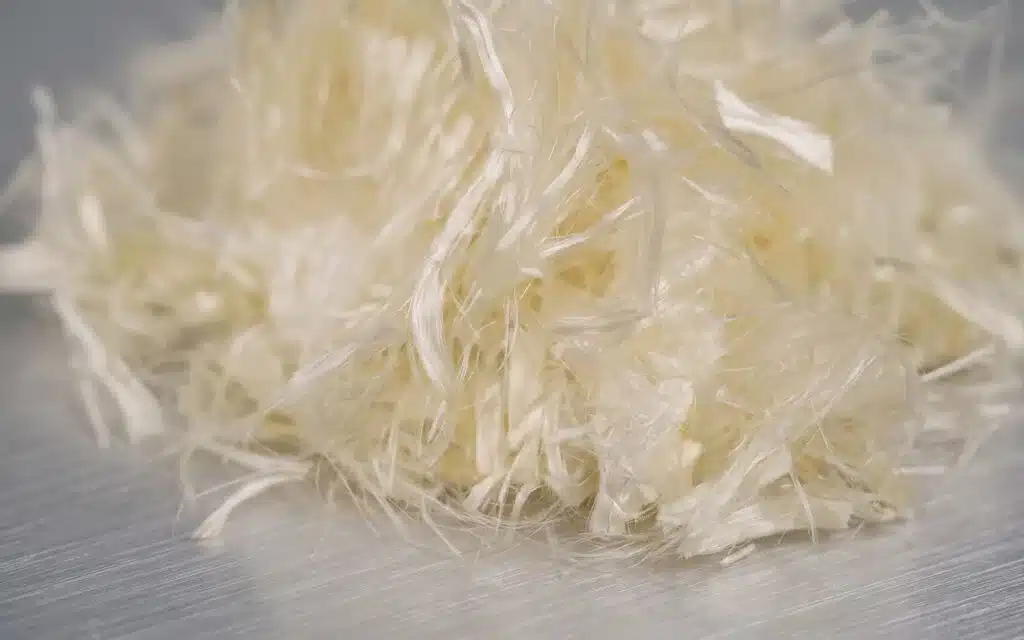
All three types share a common foundation: filament diameter 14–18 μm, heat resistance ≥200 °C, light yellow appearance, and full certification under ASTM C1116, EN 14889-2, ISO 9001:2015, and GB/T 21120.
pan fiber michem fiber for concrecte

Key Takeaways

  • Three types, three distinct missions: High-Modulus delivers infrastructure-grade crack restraint (modulus ≥4000 MPa); Alkali-Resistant ensures reinforcement durability in aggressive environments via proprietary coating; Short-Cut optimizes dispersion and surface quality in shotcrete and precast production.
  • Type-to-application mapping: High-Modulus → bridges, tunnels, industrial floors with dynamic loading; Alkali-Resistant → marine, chemical plant, de-icing salt exposure; Short-Cut 6 mm → tunnel shotcrete; Short-Cut 3 mm → architectural precast panels under 50 mm.
  • Differentiation is material-science-driven: High-Modulus = stiffness-driven micro-crack control; Alkali-Resistant = coating chemistry for pH/chloride barrier; Short-Cut = geometry-optimized dispersion and surface quality.
  • Full international certification: ASTM C1116, EN 14889-2 (Class Ia), ISO 9001:2015, GB/T 21120 — enabling specification across North America, Europe, and Asia without supplementary testing.
  • Cost-performance is lifecycle-driven: High-Modulus reduces steel reinforcement in slab-on-grade; Alkali-Resistant extends service life in aggressive exposure, lowering TCO; Short-Cut reduces mixing time and equipment wear.

Why This Answer Matters

In concrete fiber reinforcement, the costliest mistake is not the fiber unit price — it is specifying the wrong type for the service environment.

Three recurring failure modes validate type-specific selection. First, using standard-modulus fiber in high-load infrastructure produces insufficient crack restraint: micro-cracks propagate into macro-cracks under cyclic loading, accelerating water ingress and reinforcement corrosion. Second, uncoated fiber in marine or chemical environments degrades progressively — the alkaline pore solution attacks unprotected PAN surfaces, negating the reinforcement investment within 5–10 years. Third, fibers with inappropriate geometry in shotcrete or precast cause balling, uneven distribution, and surface blemishes that compromise both structural consistency and aesthetic quality.

Michem’s three-type portfolio addresses these failure modes through material-science differentiation — each type is formulated, coated, and dimensioned for its intended domain, enabling engineers to match fiber properties to project requirements precisely.

Technical Deep Dive

High-Modulus PAN Fiber: Infrastructure-Grade Crack Restraint

High-Modulus PAN fiber is engineered for structural load-bearing applications where crack control is paramount. Its elastic modulus ≥4000 MPa approaches the stiffness of early-age cement paste, ensuring the fiber engages immediately as the matrix shrinks — intercepting cracks at nucleation (widths <0.1 mm) before they become visible. At 0.9–1.2 kg/m³, millions of filaments per cubic meter create a three-dimensional micro-reinforcement network that suppresses crack initiation rather than merely bridging cracks post-formation.

Type verification testing per ASTM C1116 confirms that High-Modulus PAN meets Type II synthetic fiber requirements, while flexural performance per ASTM C1609 flexural toughness testing validates post-crack residual strength. Compliance with EN 14889-2 polymer fibers (Class Ia) certifies structural-grade performance. In type-selection reviews across bridge, marine and shotcrete projects, our technical team has consistently observed that High-Modulus PAN at 1.0 kg/m³ in bridge deck overlays reduces crack density by approximately 70%, with maximum crack widths below 0.15 mm — well within the typical 0.2 mm design limit.

Alkali-Resistant PAN Fiber: Durability in Aggressive Chemistry

Alkali-Resistant PAN fiber addresses progressive alkaline hydrolysis in high-pH concrete. Hydroxide ions attack nitrile groups on unprotected PAN surfaces, causing chain scission and eventual loss of tensile capacity. Michem’s proprietary surface coating forms a chemically inert barrier that prevents hydroxide-ion contact with the PAN substrate, maintains cement-matrix adhesion through engineered surface roughness, and remains stable at temperatures exceeding 200 °C throughout the design service life.

In type-selection reviews across bridge, marine and shotcrete projects, Alkali-Resistant PAN has proven critical in marine splash-zone structures. Core samples after 36 months of tidal exposure show 68% lower chloride penetration depth versus unreinforced controls, with no visible fiber degradation under SEM examination — confirming coating integrity through aggressive chemical cycling.

Short-Cut PAN Fiber: Process-Optimized Reinforcement

Short-Cut PAN fiber prioritizes mixing efficiency, dispersion uniformity, and surface finish quality. The 3 mm variant suits thin-section precast (<50 mm) where surface aesthetics are critical; the 6 mm variant provides enhanced crack-bridging for shotcrete and thicker precast sections. The shorter length significantly reduces balling propensity — in shotcrete applications, fibers pass smoothly through nozzles without clogging at rebound rates comparable to unreinforced designs.

Type verification testing per ASTM C1116 confirms equivalent performance to longer fibers in dispersion-critical applications, with measurable gains in mixing speed (approximately 30% faster) and surface quality (no fiber read-through on mold-face surfaces). Water-soluble paper bag packaging enables direct mixer addition without opening; the paper dissolves within 30–60 seconds of water contact.
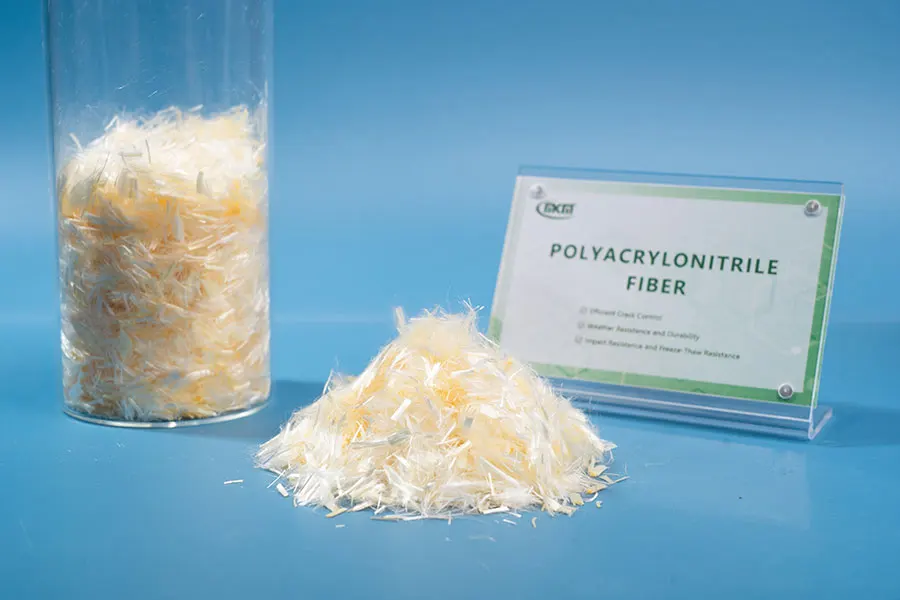
michem-yellow-pan-fiber-for-concrete Polyacrylonitrile fiber

Product Specifications

Michem PAN Fiber — Technical Data Sheet

Product Line: Michem PAN Fiber (Polyacrylonitrile Synthetic Micro-Fiber for Concrete Reinforcement)

Property

High-Modulus

Alkali-Resistant

Short-Cut

Material

100% Polyacrylonitrile (PAN)

100% Polyacrylonitrile (PAN)

100% Polyacrylonitrile (PAN)

Tensile Strength

≥800 MPa

≥750 MPa

≥700 MPa

Elastic Modulus

≥4000 MPa

Diameter

14–18 μm

14–18 μm

14–18 μm

Available Lengths

6 / 12 / 18 mm

6 / 12 / 18 mm

3 / 6 mm

Density

1.18 g/cm³

1.18 g/cm³

1.18 g/cm³

Heat Resistance

≥200 °C

≥200 °C

≥200 °C

Appearance

Light yellow, monofilament

Light yellow, coated monofilament

Light yellow, monofilament

Surface Treatment

Standard

Proprietary alkali-barrier coating

Standard

Data source: Michem PAN Fiber Technical Data Sheet. For the most current specifications, refer to michemicals.com/fiber/pan-fiber.

Certifications: ASTM C1116 (Type II synthetic fiber-reinforced concrete), EN 14889-2 (Class Ia polymer micro-fibre), ISO 9001:2015, GB/T 21120.

Packaging: Water-soluble paper bags (standard) or bulk bags; custom packaging available.

Practical Application Guide

Type Selection Decision Logic

Step 1 — Primary performance requirement:

  • Maximum crack control under structural loading → High-Modulus
  • Chemical durability in aggressive environments → Alkali-Resistant
  • Processing efficiency and surface quality → Short-Cut

Step 2 — Environmental exposure classification:

  • Exposure classes XS (seawater chlorides), XA (chemical attack), XD (non-seawater chlorides) → Alkali-Resistant recommended regardless of structural requirements
  • Exposure classes XC (carbonation), XF (freeze-thaw) with no chemical aggression → High-Modulus or Short-Cut as appropriate

Step 3 — Application method compatibility:

  • Dry-mix or wet-mix shotcrete → Short-Cut 6 mm
  • Thin precast (<50 mm section) → Short-Cut 3 mm
  • Cast-in-place structural concrete → High-Modulus or Alkali-Resistant 12 mm
  • Slipform paving → High-Modulus 12/18 mm

Dosage Guidelines by Type

Application

Recommended Type

Length

Dosage (kg/m³)

Expected Performance

Heavy-duty industrial floors

High-Modulus

12 mm

1.0–1.2

Crack reduction ≥70% vs unreinforced

Bridge deck overlays

High-Modulus

12 mm

0.9–1.2

Crack width ≤0.2 mm under fatigue

Marine splash zone structures

Alkali-Resistant

12 mm

1.2–1.5

Coating integrity maintained through tidal cycling

Chemical containment

Alkali-Resistant

12 mm

1.0–1.5

Resistance to pH 3–13 chemical exposure

Tunnel shotcrete lining

Short-Cut

6 mm

0.9–1.2

Rebound <15%, uniform distribution

Precast architectural panels

Short-Cut

3 mm

0.6–0.9

No surface read-through, faster demolding

General slabs-on-grade

High-Modulus

12 mm

0.6–0.9

Plastic shrinkage crack elimination

Sewage treatment structures

Alkali-Resistant

12 mm

1.0–1.2

Resistance to biogenic sulfuric acid attack

Mixing Recommendations

Add PAN fiber as the final batching ingredient after all aggregates, cement, and water. Mix 4–5 minutes at full speed (pan/twin-shaft mixers) or 2–3 minutes (high-shear compulsory mixers). Short-Cut fibers require approximately 30% less mixing time. Never add fibers to a dry mixer — this increases balling risk. Water-soluble paper bags can be added directly without opening.

FAQ

For structures with design service life exceeding 10 years in marine exposure (XS class), Alkali-Resistant is strongly recommended — High-Modulus lacks the protective surface coating needed for long-term durability in chloride-rich, high-pH environments. For temporary marine structures (<5-year service life), High-Modulus may be acceptable after project-specific evaluation.

PAN micro-fibers and steel macro-fibers serve complementary functions: PAN controls micro-cracking (<0.1 mm width) at plastic and early-age stages, while steel fibers provide post-crack residual strength for wider cracks. A hybrid system often delivers optimal performance. PAN fibers are non-corrosive, lighter (1.18 vs 7.85 g/cm³), and easier to pump than steel fibers.

The 3 mm variant provides superior surface finish (no fiber read-through) and faster dispersion in thin sections under 50 mm — ideal for architectural precast. The 6 mm variant offers approximately 15–20% higher post-crack residual strength due to longer embedment length. Choose 3 mm where surface aesthetics govern; choose 6 mm for structural precast and shotcrete where mechanical performance is the priority.

Yes. PAN fibers are chemically inert and compatible with all standard concrete admixtures including superplasticizers, air-entraining agents, accelerators, retarders, and waterproofing admixtures. No admixture dosage adjustment is typically required. At high fiber dosages (>1.5 kg/m³), a 5–10% increase in superplasticizer may compensate for workability reduction.

Each shipment includes: Certificate of Analysis (CoA) documenting batch-specific tensile strength, diameter, length, and moisture content; Certificate of Conformance to ASTM C1116 and EN 14889-2; ISO 9001:2015 quality system certificate; and MSDS/SDS in English and local languages. Third-party test reports available on request.

Evidence & Standards

The technical claims in this guide are substantiated by the following product data and industry standards:

  • Michem PAN Fiber Technical Data Sheet — Primary source for all mechanical property specifications, dimensional tolerances, and surface treatment descriptions.
  • ASTM C1116/C1116M — Standard Specification for Fiber-Reinforced Concrete. Michem PAN fiber certified under Type II (synthetic fiber-reinforced concrete).
  • ASTM C1609/C1609M — Standard Test Method for Flexural Performance of Fiber-Reinforced Concrete (Third-Point Loading).
  • EN 14889-2 — Fibres for Concrete, Part 2: Polymer fibres (Class Ia — micro-fibres for structural use).
  • ISO 9001:2015 — Quality management systems certification.
  • GB/T 21120 — Chinese national standard for synthetic fibres in cement, cement mortar, and concrete.

References

  1. Michem PAN Fiber Technical Data Sheet. Available at: michemicals.com/fiber/pan-fiber
  1. ASTM C1116/C1116M — Standard Specification for Fiber-Reinforced Concrete. ASTM International.
  1. ASTM C1609/C1609M — Standard Test Method for Flexural Performance of Fiber-Reinforced Concrete (Using Beam With Third-Point Loading). ASTM International.
  1. EN 14889-2:2006 — Fibres for Concrete — Part 2: Polymer fibres — Definitions, specifications and conformity. CEN.
  1. ISO 9001:2015 — Quality management systems — Requirements. ISO.
  1. GB/T 21120-2018 — Synthetic fibres for cement, cement mortar and concrete. Standardization Administration of China.

About This Guide

Intended audience: Civil and structural engineers, concrete specifiers, construction project managers, and precast/shotcrete contractors evaluating PAN fiber type selection for concrete reinforcement projects.

How this guide was produced: Based on Michem PAN Fiber product specifications, technical data sheets, third-party certification documentation, and field application experience accumulated over 12+ years of concrete reinforcement R&D.

Limitations: Type selection guidance addresses fiber properties and environmental exposure — the two primary determinants. Optimal results also depend on concrete mix design, application method, curing regime, and site conditions. Performance claims are based on laboratory testing and documented field applications; actual results vary with project variables. Always validate fiber type selection through site trials under representative project conditions.

Update policy: Reviewed at minimum annually. Latest version at michemicals.com.

Conclusion

Michem PAN Fiber’s three-type portfolio — High-Modulus, Alkali-Resistant, and Short-Cut — provides application-specific, material-science-driven solutions for concrete micro-reinforcement across infrastructure, marine, and precast construction. Selection is a fit-for-purpose decision: High-Modulus delivers maximum crack restraint for structural loads, Alkali-Resistant ensures decades of integrity in chemically aggressive environments, and Short-Cut optimizes production efficiency and surface quality.

All three types are manufactured to certified international standards with full documentation and technical support from specification through commissioning.

Picture of Sales Manager
Sales Manager

I'm Tinna,I have been engaged in the cellulose ether industry for 15 years.I'd be happy to share my post with you. If you have any good ideas, please let me know.

Please contact me for the latest quote or to request a sample test (our samples are free and include shipping).

Request Free Sample + Factory Pricing

Your inquiries answered within 6 hours. Please include your plant type and monthly volume for a tailored quote.

We will provide professional solutions to you promptly!

Request Free Sample + Factory Pricing

India inquiries answered within 4 hours. Please include your plant type and monthly volume for a tailored quote.