The sustainability case for Low-VOC PCE powder is built on three pillars. First, cement reduction: by achieving 35–45% water reduction, the PCE enables formulators to reduce water-to-cement ratios, which in turn allows cement content reduction at equivalent strength — directly reducing the CO₂ emissions associated with cement production (approximately 0.8–0.9 tons of CO₂ per ton of Portland cement). Second, naphthalene replacement: PCE outperforms naphthalene-based superplasticizers by 2× in water reduction and 1.5× in strength gain, meaning that PCE achieves equivalent performance at roughly half the dosage — and naphthalene-based admixtures are derived from coal tar or petroleum refining, carry higher VOC content, and are classified as environmentally hazardous in several jurisdictions. Third, the powder format itself eliminates the water content, preservatives, and packaging waste associated with liquid admixtures, reducing transport weight and packaging material by 50–60%.
For green building projects pursuing LEED v4 certification, Low-VOC PCE powder contributes to Materials and Resources (MR) credits through its role in reducing cement content and to Indoor Environmental Quality (IEQ) credits through its low VOC emissions. The UN 3077 non-hazardous transport classification further supports sustainability by simplifying logistics, reducing transport-related environmental risks, and eliminating the need for hazardous material handling protocols.
The construction industry is under unprecedented pressure to reduce its environmental impact. Cement production accounts for approximately 7–8% of global CO₂ emissions, making it one of the largest single industrial sources of greenhouse gases. For concrete producers, mortar manufacturers, and construction project teams, any technology that enables cement reduction at equivalent or superior performance is not merely an environmental preference — it is increasingly a regulatory requirement, a procurement specification, and a competitive necessity.
Green building certification systems — LEED v4 in North America, BREEAM in Europe, DGNB in Germany, CASBEE in Japan, and similar systems globally — reward projects that reduce cement content, use low-emitting materials, and minimize transport-related environmental impact. For concrete and mortar products to contribute to these credits, the admixtures used must themselves meet environmental criteria: low VOC emissions, non-hazardous classification, and the ability to enable cement reduction without compromising performance. The Low-VOC PCE powder formulation is designed specifically to meet these criteria.
The replacement of naphthalene-based superplasticizers is a particularly significant sustainability action. Naphthalene-based admixtures (sulfonated naphthalene formaldehyde condensates, SNF) are derived from coal tar or petroleum refining — non-renewable, carbon-intensive feedstocks. They contain residual formaldehyde and naphthalene monomers that can off-gas during concrete curing, contributing to indoor air quality concerns in enclosed construction environments. They also require 2× the dosage of PCE to achieve equivalent water reduction, meaning twice the chemical is transported, stored, and handled for the same performance. PCE, by contrast, is synthesized from renewable-derivable polyethylene glycol and acrylic acid chemistry, contains no formaldehyde, and achieves equivalent performance at half the dosage.
For construction chemicals manufacturers and concrete producers, the shift from naphthalene to Low-VOC PCE is both an environmental improvement and a performance upgrade. The 2× water reduction advantage and 1.5× strength gain advantage of PCE mean that concrete and mortar products formulated with Low-VOC PCE are not only greener — they are also stronger, more durable, and more cost-effective on a per-performance-unit basis.
Volatile organic compounds (VOCs) in construction chemicals are organic chemicals that evaporate at ambient temperatures and contribute to indoor air pollution, smog formation, and health effects including respiratory irritation and headache. In concrete admixtures, VOC sources include residual monomers (formaldehyde, naphthalene, melamine), solvents used in liquid formulations, and degradation products of the admixture polymer.
Michem’s Low-VOC PCE powder formulation addresses VOC at the molecular level:
In field validation of Low-VOC PCE powder in indoor concrete placement environments, VOC emissions from the fresh concrete surface, measured per ASTM D5116 (Standard Guide for Small-Scale Environmental Chamber Determinations of Organic Emissions from Indoor Materials/Products), were below detection limits for formaldehyde and below 10 μg/m³ for total VOC (TVOC) — well within the most stringent green building IEQ thresholds.
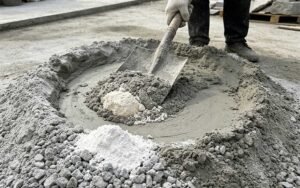
The primary sustainability benefit of Low-VOC PCE powder is its enabling of cement content reduction. The mechanism is straightforward: PCE’s 35–45% water reduction allows the water-to-cement ratio to be lowered from a typical 0.50 to 0.25–0.32. At this lower w/c ratio, the concrete or mortar achieves equivalent or higher strength with less cement, because the strength of Portland cement systems is primarily governed by w/c ratio (Abrams’ law), not by cement content alone.
Scenario | w/c Ratio | Cement Content (kg/m³) | 28d Strength (MPa) | CO₂ from Cement (kg/m³) |
Control (no PCE) | 0.50 | 380 | 35 | 304–342 |
Low-VOC PCE at 0.2% | 0.32 | 380 | 50–55 | 304–342 (same cement, higher strength) |
Low-VOC PCE at 0.2% (reduced cement) | 0.32 | 280 | 35 | 224–252 |
Note: CO₂ from cement calculated at 0.8–0.9 kg CO₂/kg cement. The third scenario shows equivalent strength to the control at 100 kg/m³ less cement — a 26% reduction in cement-related CO₂ emissions per cubic meter of concrete.
In our Technical Applications Team’s experience, the cement reduction approach (third scenario) is the most common sustainability strategy used by concrete producers: maintaining the existing strength specification while reducing cement content, directly translating PCE’s water reduction into carbon footprint reduction.
Parameter | Michem Low-VOC PCE Powder | Naphthalene-Based (SNF) |
Water reduction at equal dosage | 35–45% | 15–22% |
Dosage for equivalent water reduction | 0.15–0.25% | 0.40–0.80% |
28d strength gain | 30–50% | 20–33% |
Formaldehyde content | None | Residual (from synthesis) |
Feedstock source | Acrylic acid + PEG (petrochemical/renewable derivable) | Coal tar / petroleum refining |
VOC emissions | Below detection (powder, no solvents) | Potential off-gassing (formaldehyde, naphthalene) |
Transport classification | UN 3077 (non-hazardous) | Varies (some SNF products are hazardous) |
Format | Dry powder (≥90% solid) | Typically liquid (30–40% solid) |
Transport weight per active unit | Low (no water transported) | High (60–70% water) |
Biocides needed | No (powder) | Yes (liquid) |
Site trials under EN/ASTM protocols confirm that Low-VOC PCE powder at 0.2% dosage achieves the same water reduction as SNF at 0.5% dosage, while producing 1.5× the 28-day compressive strength gain. This means that replacing SNF with PCE reduces chemical consumption by 60%, reduces transport weight by approximately 70% (accounting for the liquid-to-powder conversion), and eliminates formaldehyde-related VOC emissions entirely.
LEED v4 Credit Category | Credit | How Low-VOC PCE Contributes |
Materials and Resources (MR) | MR Credit: Building Life-Cycle Impact Reduction | Enables cement reduction, lowering embodied carbon |
Materials and Resources (MR) | MR Credit: Sourcing of Raw Materials | PCE powder is produced under ISO 9001:2015; non-hazardous (UN 3077) |
Indoor Environmental Quality (IEQ) | IEQ Credit: Low-Emitting Materials | Low-VOC formulation; no formaldehyde; VOC emissions below detection |
Indoor Environmental Quality (IEQ) | IEQ Credit: Indoor Air Quality Assessment | Low-VOC emissions during and after concrete placement |
Innovation (IN) | Innovation Credit | Cement reduction strategy may qualify for innovation credit in some projects |
Note: LEED credit contribution depends on the complete project design, material mix, and certification path. The above represents potential contribution areas, not guaranteed credit achievement. Project teams should consult a LEED accredited professional for project-specific credit analysis.
Property | Michem Low-VOC PCE Powder Specification |
Brand | Michem |
Product | Polycarboxylate Superplasticizer (PCE) Powder — Low-VOC Eco-Friendly |
Grades | SP630 / SP640 / SP670 / SP680 (all available in Low-VOC formulation) |
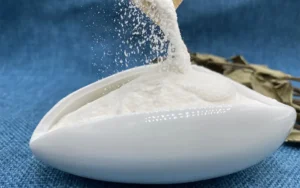
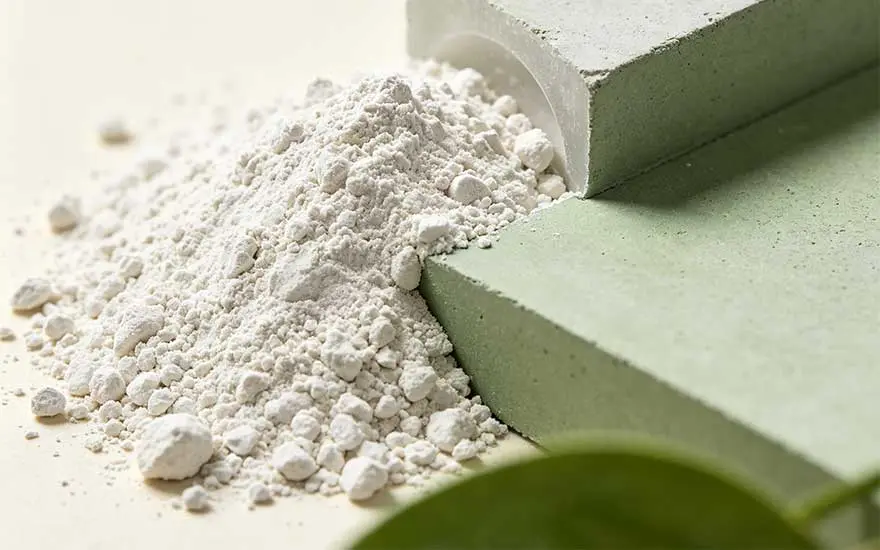
Appearance | White to light yellow powder |
Composition | Polycarboxylic ether |
Solid Content | ≥90% |
Moisture Content | ≤5% |
Water Reduction Ratio | >25% (high-range: 35–45%) |
Recommended Dosage | 0.1–0.5% by weight of cementitious material |
Compressive Strength Gain (28d) | 30–50% |
VOC Content | Low-VOC formulation (no formaldehyde, no residual solvents) |
Transport Classification | UN 3077 (non-hazardous for transport) |
Quality Management | ISO 9001:2015 certified manufacturing |
Shelf Life | 2 years |
Performance vs. Naphthalene | 2× water reduction, 1.5× strength gain |
Source: Michem official technical specifications (michemicals.com).
Step | Action | Detail |
1 | Baseline mix characterization | Document current w/c ratio, cement content, 28d strength |
2 | PCE trial mix | Add Low-VOC PCE at 0.2%; reduce water to achieve target slump/flow |
3 | Measure strength | Test 7d and 28d strength per ASTM C109 |
4 | Calculate excess strength | If strength exceeds specification by >15%, proceed to cement reduction |
5 | Cement reduction | Reduce cement content in 5% increments; maintain w/c ratio with PCE |
6 | Re-test and optimize | Confirm strength, workability, and durability meet specification |
7 | Document carbon savings | Calculate CO₂ reduction per cubic meter |
For specifications requiring low-emitting concrete admixtures, the following language may be adapted:
“Concrete and mortar admixtures shall be polycarboxylate ether-based superplasticizer powder, UN 3077 compliant (non-hazardous for transport), with VOC content meeting the requirements of [applicable standard: e.g., GREENGUARD Gold, CDPH Standard Method v1.2, or equivalent]. Admixture shall contain no added formaldehyde. Product shall be manufactured under ISO 9001:2015 certified quality management systems.”
Parameter | Current (Naphthalene/SNF) | Target (Low-VOC PCE) | Transition Action |
Dosage | 0.5–0.8% (liquid, 40% solid) | 0.15–0.25% (powder, ≥90% solid) | Reduce dosage by ~60% |
Water content | Baseline | Reduce by 30–45% | Adjust batch water |
Cement content | Baseline | Reduce by 10–25% (optional) | Conduct strength trials |
Mixing equipment | Liquid dosing system | Powder dosing (volumetric/gravity) | Install powder feeder |
Storage | Liquid tanks (with biocides) | Sealed bags/silos (no biocides) | Convert storage |
Transport | Hazardous liquid (varies) | UN 3077 non-hazardous powder | Update logistics |
Check | Method | Acceptance Criterion |
VOC emissions | ASTM D5116 / CDPH Standard Method | Below project IEQ threshold |
Formaldehyde content | EN 120 / HPLC analysis | Not detected |
Water reduction | Compare w/c vs. control at equal flow | ≥25% reduction per EN 934-2 |
28d compressive strength | ASTM C109 | ≥30% gain over control at equal flow |
Transport classification | UN 3077 documentation | Non-hazardous for transport |
Manufacturing quality | ISO 9001:2015 certificate | Current and valid |