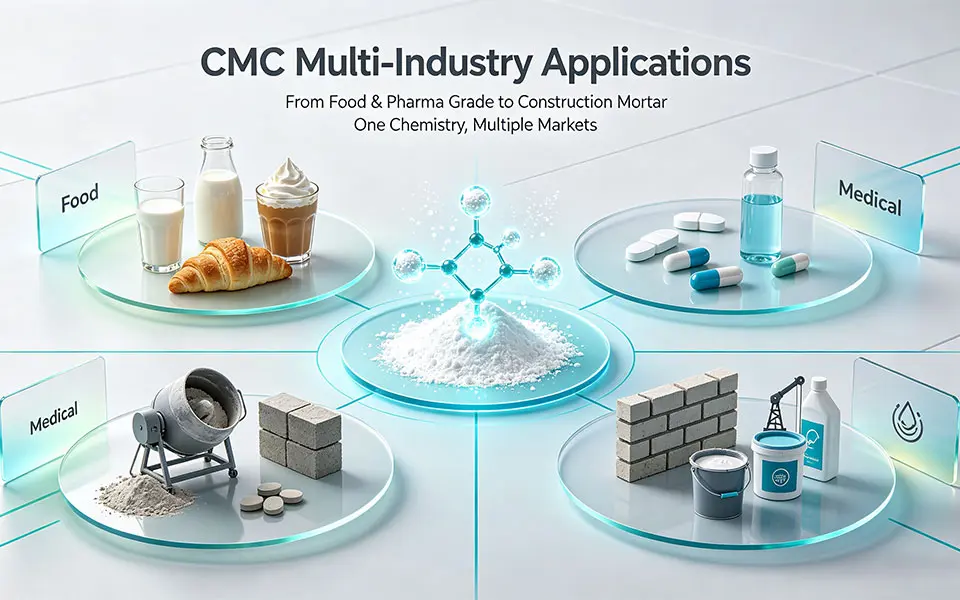
CMC (Carboxymethyl Cellulose) serves five major industries — food (thickener, stabilizer E466), pharmaceuticals (binder, disintegrant), cosmetics (viscosity modifier), detergents (anti-redeposition agent), and construction (water retention in mortar) — all derived from the same fundamental chemistry: an anionic cellulose backbone carrying carboxymethyl groups at DS 0.65–0.9. Each industry exploits the same water-binding mechanism — carboxylate groups immobilize water through ion-dipole interactions and hydrogen bonding — but optimizes the polymer differently for its end use.
Food-grade demands the highest purity (≥99.5% active content, heavy metals <10 ppm) and DS 0.65–0.85 for smooth mouthfeel and thermal stability. Pharmaceutical grade requires pharmacopeial compliance (USP/EP/JP), validated residue limits, and DS 0.7–0.9 for rapid tablet disintegration. Construction grade leverages the same water-binding chemistry at lower regulatory burden — purity ≥99.5%, DS 0.7–0.9 maximizing water retention at dosage 0.1–0.3%.
The key insight: construction CMC users benefit from understanding food and pharma quality frameworks. The analytical methods, DS precision targets, and impurity limits developed for E466 compliance directly transfer to construction-grade quality assurance — enabling mortar formulators to adopt validated testing protocols from industries with far more rigorous regulatory oversight.
Understanding CMC’s multi-industry footprint provides construction formulators with a proven quality framework borrowed from the most regulated industries on earth. Food-grade CMC (E466) undergoes EFSA/FDA review for daily ingestion by millions of consumers; pharmaceutical-grade CMC passes USP validation for direct patient contact. These industries have invested decades developing analytical methods for DS precision (±0.02), impurity detection (heavy metals at ppm level), and performance reproducibility — all of which directly govern the same physical properties that determine mortar water retention, open time, and bond strength.
When a construction QC team adopts food-industry testing protocols for incoming CMC verification — titration-based DS measurement per ASTM D1439, Brookfield viscosity profiling at standardized conditions — they eliminate the most common causes of field performance drift: batch-to-batch DS variation, undetected purity drops, and viscosity inconsistency. This cross-industry intelligence transfer transforms CMC sourcing from commodity purchasing to specification-driven qualification.
All CMC grades share the identical molecular architecture: a β-1,4-linked anhydroglucose backbone substituted with –CH₂COONa groups at C2, C3, and C6 hydroxyl positions. The degree of substitution (average carboxymethyl groups per glucose unit) determines charge density, water-binding capacity, and solution behavior — regardless of whether the end product is ice cream, a tablet, face cream, laundry detergent, or tile adhesive.
The carboxymethylation reaction — alkali cellulose treated with sodium monochloroacetate under controlled temperature and time — is the same industrial process for all grades. What differentiates food, pharma, and construction CMC is not the chemistry but the downstream purification, DS targeting, and quality verification:
Parameter | Food Grade (E466) | Pharmaceutical Grade (USP) | Construction Grade |
DS range | 0.65–0.85 | 0.7–0.9 | 0.65–0.9 |
Purity (active content) | ≥99.5% | ≥99.5% | ≥99.5% |
Heavy metals | <10 ppm total | <20 ppm total | Not typically specified |
Lead | <2 ppm | <5 ppm | Not typically specified |
Arsenic | <1 ppm | <3 ppm | Not typically specified |
Chloride (NaCl) | ≤0.5% | ≤0.5% | ≤0.5% |
Water insoluble | ≤0.3% | ≤0.5% | ≤0.3% |
Drying loss | ≤8.0% | ≤10.0% | ≤8.0% |
pH (1% solution) | 6.5–8.5 | 6.5–8.5 | 6.5–8.5 |
Microbial limits | <1000 CFU/g | <100 CFU/g | Not typically specified |
Residual solvents | Not specified | Per ICH Q3C | Not specified |
Viscosity range | 400–6000 mPa·s | 400–8000 mPa·s | 400–8000 mPa·s |
Regulatory compliance | EFSA E466, FDA CFR21 | USP, EP, JP | Industry specification |
The physical-chemical parameters that govern construction performance (DS, purity, chloride, water-insoluble matter, viscosity) overlap entirely with food and pharma specifications. The difference lies in additional safety parameters that food and pharma require for human exposure — but these same parameters, when verified, provide assurance that the base polymer quality exceeds construction requirements.
Food industry: DS 0.65–0.85 balances viscosity contribution with thermal cycling stability. In dairy products, CMC at DS 0.7–0.8 prevents ice crystal growth by immobilizing free water while maintaining smooth mouthfeel. In baked goods and sauces, DS 0.65–0.75 provides thickening without excessive gel strength.
Pharmaceutical industry: DS 0.7–0.9 enables dual functionality — as a tablet binder at DS 0.7–0.8 providing compressibility and inter-particle adhesion; as a disintegrant at DS 0.85–0.9 creating rapid hydration channels that fracture the tablet matrix within 15–30 minutes per USP disintegration testing.
Construction industry: DS 0.7–0.9 maximizes water retention in cement-based mortars against two competing forces: evaporation and substrate suction. Each 0.1 DS increment adds ~8–12% water retention capacity, directly translating to longer open time and higher cement hydration percentage. Construction-grade testing per ASTM D1439 confirms that DS variance as small as ±0.05 produces measurable water retention differences in cement-based mortars — explaining why food-industry DS titration protocols deliver immediate practical value to construction QC workflows.
Detergent industry: DS 0.5–0.7 suffices for anti-redeposition — CMC adsorbs onto soil particles via carboxylate-anchor mechanism, preventing re-attachment to fabric surfaces. Lower DS is acceptable because detergent formulations operate at high ionic strength where chain extension is naturally compressed.
In cross-industry specification reviews, the most common oversight we observe is construction formulators treating CMC as a commodity powder rather than a performance polymer — the same DS precision that ensures ice cream shelf stability directly governs whether tile adhesive achieves 30-minute open time on site. The most valuable cross-industry lesson is analytical methodology transfer:
Pillar 1 — DS verification by acid-wash titration (per ASTM D1439 DS): Food manufacturers verify every batch DS to ±0.02 tolerance. Construction QC labs often skip DS testing — this is the primary cause of field performance drift. Titration-based DS verification takes 2 hours per batch and eliminates DS-related performance variance.
Pillar 2 — Viscosity profiling at standardized conditions: Food labs measure Brookfield viscosity at 1% concentration, 25°C, specified spindle and RPM. Construction labs should adopt the same protocol rather than accepting vendor-reported viscosity at unspecified conditions.
Pillar 3 — Impurity screening: Food-grade testing for sodium glycolate (carboxymethylation by-product) detects incomplete purification that manifests as elevated chloride and water-insoluble residue in construction grade. Adopting these screens catches quality problems before CMC enters mortar production.
Parameter | Specification |
Degree of Substitution (DS) | 0.65–0.90 (customizable by order) |
Purity (active content) | ≥99.5% |
Chloride (as NaCl) | ≤0.5% |
Drying loss | ≤8.0% |
pH (1% solution, 25°C) | 6.5–8.5 |
Water insoluble matter | ≤0.3% |
Viscosity (1% solution, 25°C, Brookfield) | 400–8000 mPa·s (customizable by grade) |
Type | Anionic |
Recommended dosage (dry-mix mortar) | 0.1%–0.3% by total dry weight |
Applications | Food, pharmaceuticals, cosmetics, detergents, ceramics, oil field, construction |
Source: Michem CMC Technical Data Sheet. Available at michemicals.com/cellulose-ether/cmc
Standard packaging: 25 kg multi-wall paper bag with inner PE liner. Custom packaging available upon request.
1. Request DS certificates with every delivery — Food manufacturers never accept CMC without per-batch DS verification. Specify DS range (e.g., 0.75–0.85 for tile adhesive) on purchase orders and require supplier certification with titration data. A 0.05 DS deviation can cause 10–15% water retention variance — enough to shift open time from 30 minutes to 20 minutes on a hot-weather project.
2. Implement incoming viscosity profiling — Set up a standardized Brookfield viscosity test (1% solution, 25°C, LV spindle #3 at 60 RPM). Test every incoming batch against your target viscosity window. This 15-minute test catches molecular weight variation that directly affects mortar workability and anti-sag performance.
3. Screen for sodium glycolate — This carboxymethylation by-product is a standard food-grade impurity test. In construction, elevated sodium glycolate (>0.4%) correlates with higher chloride content and reduced water retention efficiency. Ion chromatography screening identifies purification quality before CMC enters production.
4. Specify water-insoluble matter rigorously — Food-grade CMC limits water insoluble to ≤0.3%. Enforce this same limit for construction grade, because insoluble residue creates gel particles in wet mortar that produce surface defects in finished plaster and putty applications.
5. Cross-reference pharma disintegration testing for dissolution validation — Pharmaceutical USP disintegration testing (tablet dissolution in water) is conceptually identical to CMC dissolution in mortar mixing water. Grades that hydrate within 30 seconds in USP testing will hydrate fully within 5–10 minutes in mortar mixing — well within typical mixing cycles.
Construction Application | Recommended DS | Viscosity Grade | Dosage (%) | Cross-Industry Reference |
Tile adhesive | 0.75–0.85 | 2000–5000 mPa·s | 0.15–0.25 | Same DS range as pharma tablet binder grade |
Wall putty | 0.70–0.80 | 1000–3000 mPa·s | 0.10–0.20 | Same DS range as food dairy stabilizer |
Self-leveling underlayment | 0.80–0.90 | 400–1500 mPa·s | 0.05–0.15 | Same DS range as pharma fast-disintegrant |
EIFS adhesive | 0.75–0.85 | 3000–6000 mPa·s | 0.15–0.30 | Same DS range as food bakery thickener |
Gypsum joint compound | 0.65–0.75 | 2000–4000 mPa·s | 0.10–0.20 | Same DS range as detergent anti-redeposition grade |
Because food-grade quality parameters (DS precision, purity, water-insoluble matter, chloride) are the exact same parameters that govern mortar performance. Food manufacturers have invested decades in validated testing methods for these parameters — methods that construction QC can adopt directly. A CMC batch that meets E466 food-grade specifications automatically exceeds construction-grade performance requirements.
Technically yes — food-grade CMC meets all construction performance parameters. However, food-grade carries unnecessary cost premium from heavy metal testing, microbial validation, and regulatory compliance documentation. For construction applications, specify ≥99.5% purity, DS 0.7–0.9, chloride ≤0.5%, and water-insoluble ≤0.3% — matching food-grade physical performance without the regulatory overhead cost.
DS 0.7–0.85 overlaps both industries. In food, this range provides moderate-to-high viscosity with thermal stability for sauces, dairy, and baked goods. In construction, it delivers 85–92% water retention in thin-layer mortars at 0.1–0.3% dosage. DS 0.9 is preferred in pharmaceutical fast-disintegrant and construction self-leveling applications where rapid hydration at low dosage is critical.
Both mechanisms rely on carboxylate anchoring. In detergents, CMC carboxylate groups adsorb onto soil particle surfaces, creating a negatively charged barrier that prevents re-deposition onto fabric. In construction, the same anionic groups adsorb onto cement particle surfaces, improving particle dispersion and preventing premature flocculation — enhancing mortar workability and contributing to uniform cement hydration.
Start with DS verification by titration (ASTM D1439). This single test — requiring ~2 hours and standard laboratory glassware — catches the most common cause of field performance drift. If your supplier’s DS certificate claims 0.80, verify it. A batch arriving at DS 0.65 instead of 0.80 causes ~20% water retention loss — enough to fail open-time testing. After DS verification is routine, add Brookfield viscosity profiling and water-insoluble matter testing.
The technical claims in this guide are supported by the following evidence base:
Who this guide is for: Construction formulators, quality control teams, procurement specialists, and technical managers seeking to understand CMC’s cross-industry performance profile and apply food/pharma quality frameworks to construction-grade material selection.
How this guide was produced: Compiled by the Michem Technical Applications Team based on 12+ years of cellulose ether R&D, cross-industry specification reviews, and direct formulator support across food, pharmaceutical, and construction sectors.
Limitations: Food-grade and pharmaceutical-grade CMC carry additional purity and regulatory requirements (heavy metal testing, microbial validation, residual solvent limits, pharmacopeial compliance documentation) not fully covered in this construction-focused guide. Verify regulatory status and grade suitability independently before commercial use. This guide provides technical reference only and does not constitute regulatory or legal advice.
Update policy: This guide is reviewed annually and updated when Michem product specifications, referenced industry standards, or application guidance change. Last reviewed: July 2026.
CMC’s multi-industry versatility — from E466 food stabilizer to USP pharmaceutical binder to construction mortar water-retention agent — stems from one chemistry: anionic carboxymethyl groups on a cellulose backbone that bind water, control viscosity, and form films. The construction industry gains most by adopting the quality verification frameworks that food and pharmaceutical industries have refined over decades — not by purchasing higher-cost regulated grades, but by applying their testing rigor to construction-grade material qualification.
Michem CMC delivers the full performance spectrum — DS 0.65–0.9, viscosity 400–8000 mPa·s, purity ≥99.5% — in grade configurations optimized for each application, backed by the same analytical precision that food and pharmaceutical manufacturers require.

I'm Tinna,I have been engaged in the cellulose ether industry for 15 years.I'd be happy to share my post with you. If you have any good ideas, please let me know.
Please contact me for the latest quote or to request a sample test (our samples are free and include shipping).
Your inquiries answered within 4 hours. Please include your plant type and monthly volume for a tailored quote.
We will provide professional solutions to you promptly!
The inquiries answered within 4 hours. Please include your plant type and monthly volume for a tailored quote.