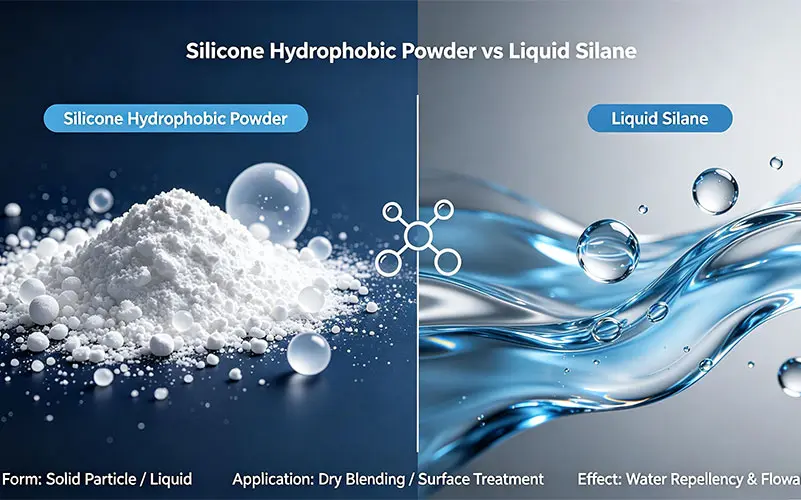
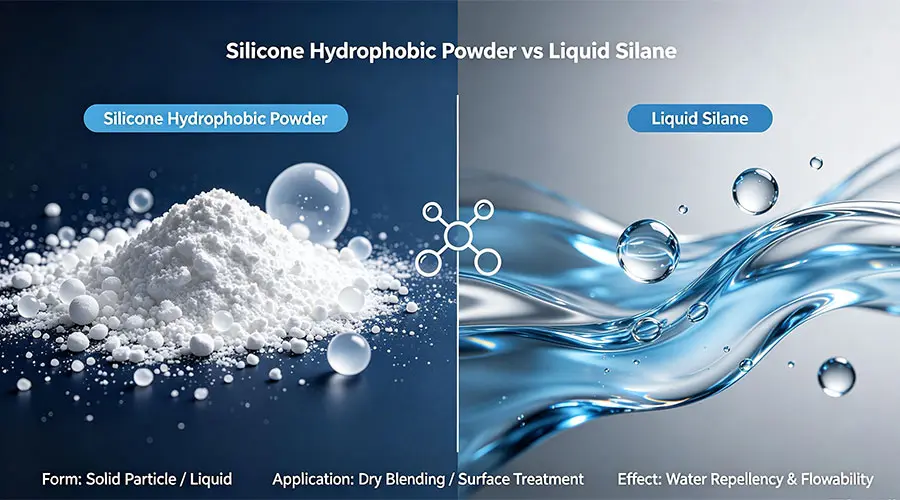
Liquid silane follows a different path. It must be sprayed into the blender, wet individual particles, and be redistributed by extended mixing — producing localized “hot spots” alongside under-treated “cold spots.” The liquid carrier can also trigger premature cement reaction, migrate under gravity in stacked pallets, or volatilize through standard packaging, degrading hydrophobicity and workability over shelf life.
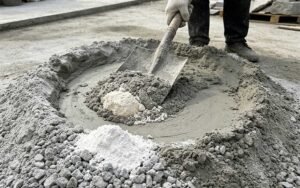
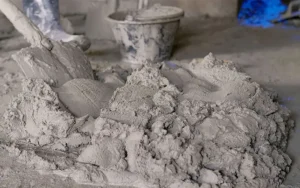
For dry-mix mortar, where pre-bagged product may sit for months before use, powder-form silicone water repellent delivers three things liquid silane cannot: uniform distribution, stable shelf life, and production-line simplicity. That makes it the rational default for any serious dry-mix producer.
For dry-mix mortar producers, the water-repellent choice is not a marginal chemical preference — it shapes production line design, capital expenditure, quality consistency, and customer satisfaction.
Most dry-mix plants run ribbon blenders or gravity mixers built for dry powders. Retrofitting for liquid silane means installing heated storage (silane viscosity climbs at low temperature), precision metering pumps, atomizing spray systems, and extended mixing cycles. The capital outlay and ongoing maintenance of pump seals, nozzles, and heated lines become a permanent operational burden.
Product quality is equally at stake. A bag of dry-mix mortar with uneven water repellency produces patchy waterproofing on site — some zones bead water, others absorb it. That inconsistency generates complaints, rework, and brand damage that far outweigh any marginal chemical savings. Because powder is a dry particulate additive, it guarantees every gram of mortar carries the target dosage, uniformly distributed and ready to activate when water is added. For producers whose reputation rests on consistent performance, that reliability is non-negotiable.
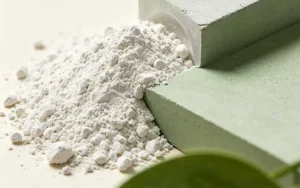
Silicone hydrophobic powder carries a silicone-based hydrophobic compound on a solid carrier matrix. When dry-blended into mortar and later mixed with water on site, the carrier disperses and releases the active silicone molecules. These hydrolyze to form silanol groups (Si–OH) that chemically bond with hydroxyl groups on cement hydration products, aggregate surfaces, and capillary pore walls. The result is a nanoscale silicone network covalently anchored to the substrate, lowering surface energy so liquid water beads on pore walls and cannot wick by capillary action. The pores remain physically open, preserving vapor permeability so the mortar breathes.
Liquid silane (typically alkyltrialkoxysilane in solvent or emulsion) follows the same chemistry, but the delivery pathway differs fundamentally. Sprayed into a dry-mix blender, it must wet powder particles, spread across irregular surfaces, and partially hydrolyze. The liquid phase creates transient agglomerates that extended mixing must break down, leaving hydrophobic hot spots and untreated cold spots. The carrier can also disturb the moisture balance of the dry mix and risk cement pre-hydration.
This is the decisive differentiator. In dry-mix plant trials comparing powder vs liquid dosing, powder-delivered systems consistently achieve tighter batch-to-batch and within-batch uniformity than liquid-sprayed systems. The physics explains why: a dry powder particle carrying the active ingredient distributes through the billions of particles in a ton of dry mortar by simple mechanical blending. A liquid spray droplet must hit individual particles, spread across irregular surfaces, and avoid being absorbed into porous aggregate. The probability of true uniformity via spraying into a dry powder mass is low, and the gap widens at scale.
Rather than rely on vendor claims, producers should verify water repellency with standardized methods. Water absorption testing under EN 1015-18 confirms the capillary water absorption coefficient of hardened mortar — the core metric for any hydrophobic admixture. Consistence is measured per EN 1015-3 to confirm the additive does not disrupt workability, and water vapor permeability per EN 1015-19 confirms the mortar still breathes. A properly dosed silicone hydrophobic powder, evaluated against an untreated control across these three EN standards, demonstrates effective water absorption reduction while retaining workability and vapor permeability.
Liquid silane in dry mixes faces several degradation pathways: residual moisture or solvent can trigger slow cement hydration; small silane molecules can volatilize through standard bags; and free liquid can migrate downward in stacked pallets, creating concentration gradients. Silicone hydrophobic powder avoids all of these because the active ingredient is bound to a solid carrier until water is added at the job site.
The processing contrast is stark. Powder workflow: weigh the powder (0.1%–1.0% of batch weight), add to the blender with other dry components, mix for the standard cycle, discharge, bag, and ship. Liquid silane workflow: maintain heated storage, calibrate the metering pump, spray silane in during extended mixing, mix further to break agglomerates, monitor discharged moisture, clean spray nozzles daily, and use vapor-barrier packaging. Powder eliminates heated storage, spraying, nozzle cleaning, and special packaging — shorter batch cycles, lower operator skill demands, and no interference with cement hydration at recommended dosages.
Michem’s Silicone Hydrophobic Powder is engineered for dry-mix mortar, plaster, grout, putty, and waterproofing systems.
Property | Specification |
Appearance | White / off-white powder |
Active ingredient | Silicone-based hydrophobic compound |
Bulk density | 300–600 g/L |
Moisture | ≤5% |
pH | Neutral to slightly alkaline |
Recommended dosage | 0.1%–1.0% by weight of dry mix |
Applications | Mortar, plaster, grout, putty, waterproofing systems |
Source: Michem Silicone Hydrophobic Powder product specifications, michemicals.com. Confirm dosage by site testing against the target EN 1015-18 water absorption coefficient for your formulation.
Choose powder when your line handles only dry blending, when you produce pre-bagged mortar with shelf life beyond a few months, when customers expect consistent water repellency batch to batch, and when you want to avoid capital investment in liquid-handling infrastructure. It is also right for breathable systems such as exterior renders and EIFS base coats where vapor permeability per EN 1015-19 matters, and for plants in cold climates where liquid silane viscosity becomes problematic.
Liquid silane may still suit wet-mix or ready-mix consumed immediately, surface-applied (not integral) waterproofing, or where a fully depreciated liquid dosing line already exists and switching cost outweighs benefit.
The per-kilogram raw material cost of powder can exceed liquid silane on an active basis, but raw material is only one cost line. A fair comparison must account for:
Even where liquid silane is cheaper per active kilogram, the equipment, throughput, and quality costs typically exceed the savings within the first year.