
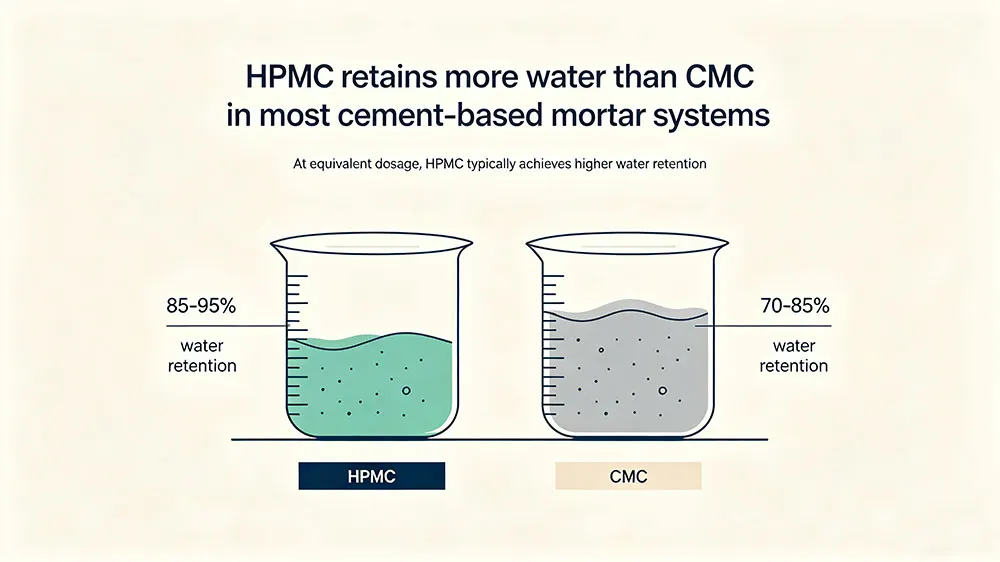
Water retention is the single most important function of cellulose ethers in dry-mix mortar. Without adequate water retention, mixing water dewaters into absorbent substrates or evaporates before cement hydrates, producing incomplete hydration, reduced bond strength, premature skinning, and shrinkage cracking. Tile delamination, hollow renders, and cracked skim coats are the visible failure modes — and they all trace back to insufficient water retention at the mortar-substrate interface.
Cellulose ethers typically exceed 30% of total additive spending in a dry-mix formulation. The choice between CMC and HPMC directly determines both performance reliability and additive cost. Over-specifying HPMC where CMC suffices wastes money; under-specifying with CMC where HPMC is needed risks job-site failure. Formulators who understand the quantitative retention gap and its root causes can make informed decisions that optimize cost without compromising critical performance — and this is precisely the decision that determines whether a mortar product succeeds or fails in the field.
Cellulose ethers retain water in mortar through two concurrent mechanisms: physical pore plugging (swollen polymer chains occluding capillary pores to slow water migration) and solution viscosity increase (thickening the aqueous phase to reduce hydraulic conductivity toward absorbent substrates). Both mechanisms depend on the polymer maintaining its dissolved, swollen state throughout the mortar’s working life — typically 20–30 minutes for tile adhesive application.
HPMC’s mixed methoxyl/hydroxypropoxyl substituents create a more effective hydration shell around each polymer chain. The methoxyl groups (19–24%) reduce hydrogen bonding between chains, promoting individual chain extension and maximizing the hydrodynamic volume per unit mass. The hydroxypropoxyl groups (4–12%) introduce hydrophilic side chains that strengthen water binding. Together, these substituents give HPMC superior water-holding capacity per molecule compared to CMC’s carboxymethyl groups alone.
CMC’s carboxymethyl groups (-CH₂COONa) provide strong initial thickening — the anionic charge creates electrostatic repulsion between chains, expanding hydrodynamic volume at low concentrations. However, this advantage collapses in cement systems. Dissolved Ca²⁺ ions from cement hydration bind to carboxylate groups, neutralizing electrostatic repulsion and forming calcium carboxymethyl cellulose complexes that reduce chain extension, collapse viscosity, and release previously retained water.
The fundamental retention gap originates from ionic character. HPMC carries only neutral methoxyl and hydroxypropoxyl substituents — no ionizable groups. Its thickening and water-holding performance are entirely physical, unaffected by pH, electrolyte concentration, or calcium ions. CMC carries ionizable carboxylate groups that drive both its cost advantage (sodium monochloroacetate is cheaper than the methyl chloride/propylene oxide combination used for HPMC) and its performance limitation (ion sensitivity in alkaline cement environments).
In gypsum-based systems (pH 6–8), Ca²⁺ concentration remains low, and CMC’s carboxylate groups stay fully ionized, maintaining chain extension and thickening efficiency. This is why CMC performs comparably to HPMC in gypsum plaster and joint compound — the chemistry that limits CMC in cement simply does not activate.
Using the filter paper method (EN 413-2 modified) at 20 minutes, typical results for a cement tile adhesive formulation (35% OPC, 65% sand) are:
Cellulose Ether | Dosage | Water Retention (%) |
Michem HPMC MH100K | 0.05% | 92 |
Michem HPMC MH100K | 0.03% | 88 |
Michem CMC (DS 0.8) | 0.05% | 68–72 |
Michem CMC (DS 0.8) | 0.10% | 75–78 |
Michem CMC (DS 0.8) | 0.15% | 80–83 |
Michem CMC (DS 0.65) | 0.05% | 62–65 |
Michem CMC (DS 0.65) | 0.10% | 70–73 |
In a gypsum plaster formulation (75% hemihydrate, 25% filler), results shift significantly:
Cellulose Ether | Dosage | Water Retention (%) |
Michem HPMC MH75K | 0.05% | 91 |
Michem CMC (DS 0.8) | 0.10% | 88–90 |
Michem CMC (DS 0.8) | 0.15% | 92–94 |
The gypsum data confirms that CMC’s anionic chemistry is not inherently inferior — it is environment-dependent. Where Ca²⁺ concentration is low and pH is neutral, CMC approaches HPMC performance at roughly 2× dosage.
Assume construction-grade HPMC at USD 3.50/kg and CMC at USD 1.80/kg (representative market pricing, 30–50% spread). For a cement tile adhesive requiring ≥90% water retention:
In this scenario, CMC costs more per ton of dry mix and fails the performance requirement. HPMC is both cheaper in use and higher-performing.
For gypsum plaster requiring ≥88% water retention:
In gypsum, CMC delivers equivalent performance at essentially the same cost-in-use, with the added advantage of rapid cold-water solubility and no thermal gelation interference with gypsum setting.
Degree of substitution directly affects CMC retention performance. Higher DS (0.8–0.9) means more carboxymethyl groups per anhydroglucose unit, which:
However, DS improvement is incremental, not transformative. Moving from DS 0.65 to DS 0.9 improves water retention by approximately 5–8 percentage points in cement systems at the same dosage — a meaningful gain but insufficient to close the 15–25 percentage point gap with HPMC. For gypsum systems, the DS effect is smaller (2–3 percentage points) because calcium interference is minimal.
Parameter | Specification |
CAS Number | 9004-32-4 |
Degree of Substitution (DS) | 0.65–0.9 |
Purity | ≥99.5% |
Chloride Content | ≤0.5% |
Drying Loss | ≤8.0% |
pH (1% solution) | 6.5–8.5 |
Water Insoluble | ≤0.3% |
Ionic Type | Anionic |
Viscosity (Brookfield, 1% solution) | 400–8,000 mPa·s (customizable) |
Mortar Dosage | 0.1%–0.3% |
Source: michemicals.com
Grade | Viscosity (mPa·s) | Key Applications |
MH04K | 400–500 | Self-leveling compounds, flowable screeds |
MH75K | 35,000–40,000 | Interior wall putty, gypsum plaster |
MH100K | 45,000–60,000 | Standard tile adhesive (C1), general-purpose mortar |
MH150K | 55,000–65,000 | High-performance tile adhesive (C2), repair mortar |
MH200K | 65,000–80,000 | EIFS base coat, waterproofing mortar |
MH200D | 65,000–80,000 | Extended open-time tile adhesive (C2E), hot-climate formulations |
Additional HPMC Specifications:
Parameter | Specification |
Methoxyl Content | 19–24% |
Hydroxypropoxyl Content | 4–12% |
Moisture | ≤5% |
Ash Content | ≤5% |
pH (1% solution) | 6–8 |
Gelation Temperature | 60–70°C |
Source: michemicals.com
Gypsum-based plasters and joint compounds (pH 6–8). CMC at 0.10–0.20% dosage provides 88–92% water retention, comparable to HPMC. Gypsum’s neutral pH avoids CMC’s calcium sensitivity entirely. CMC’s rapid cold-water solubility also simplifies mixing protocols compared to HPMC’s thermal hydration requirement. This is CMC’s strongest application for water retention.
Interior wall putty (cost-sensitive). Where price competition dominates specification, CMC at 0.15–0.25% fully replaces HPMC. Accept slightly reduced open time and marginally higher cracking risk. Not suitable for exterior use where moisture cycling demands HPMC’s film integrity.
General-purpose masonry mortar (Type N). CMC at 0.10–0.20% with a small HPMC supplement (0.02–0.03%) provides workable rheology for non-structural, interior applications.
Ceramic tile production (binder). Michem CMC is confirmed for ceramic bodies, glaze slips, and fancy glazes where its anionic character and film-forming ability support green strength and casting performance.
Application | HPMC Dosage | CMC Dosage (if used) | CMC Feasibility |
Tile adhesive (C1/C2) | 0.03–0.08% | Not recommended | Not feasible |
Exterior wall putty | 0.05–0.10% | Not recommended | Not feasible |
Gypsum plaster | 0.02–0.06% | 0.10–0.20% | Fully feasible |
Interior wall putty | 0.04–0.08% | 0.15–0.25% | Feasible (cost trade-off) |
Masonry mortar (interior) | 0.02–0.04% | 0.10–0.20% | Feasible with HPMC supplement |
EIFS base coat | 0.06–0.12% | Not recommended | Not feasible |
Self-leveling compound | 0.02–0.05% | Not recommended | Not feasible |
For gypsum spray plaster, a 50:50 CMC/HPMC blend at combined 0.30% dosage (0.15% each) achieves 15–20% cellulose ether cost reduction while maintaining workability and surface finish. The HPMC fraction provides film integrity and extended open time; the CMC fraction provides rapid thickening and cost reduction. This is the most cost-effective strategy where CMC can partially contribute to water retention without fully replacing HPMC.