
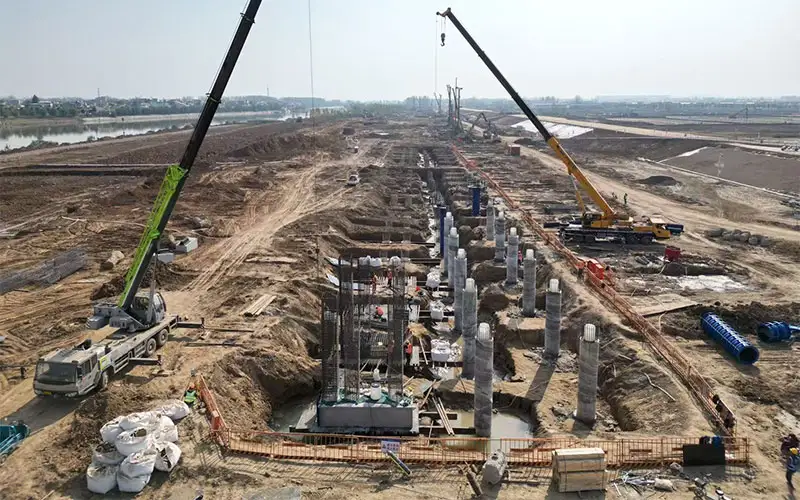
Infrastructure projects operate under some of the most demanding engineering specifications in construction. A highway bridge deck in freeze-thaw conditions, a sewage treatment basin exposed to alkaline wastewater, or a tunnel lining subjected to cyclic loading — each demands a fiber reinforcement strategy tailored to its specific degradation mechanisms. Specifying the wrong PAN fiber type can result in premature cracking, reduced service life, and costly remediation. Conversely, over-specifying (e.g., using High-Modulus fiber where Short-Cut suffices) inflates material costs without proportional performance gains.
The specification process also intersects with compliance: public works projects in most jurisdictions require materials meeting recognized standards such as ASTM C1116 or EN 14889-2. Engineers and procurement teams need to map fiber grades not only to performance requirements but also to the certification framework required by the project’s governing specifications. This guide provides the technical basis for making those mapping decisions correctly and defensibly.
High-Modulus PAN fiber is the specification of choice when the primary design concern is controlling plastic shrinkage cracking and improving post-crack residual strength. With tensile strength ≥800 MPa and elastic modulus ≥4000 MPa, this grade provides stiffness that closely approaches the elastic modulus of early-age concrete, ensuring effective stress transfer between fiber and matrix before cracking initiates.
Key specifications:
Engineering rationale: The high modulus is critical because fiber efficiency in restraining micro-cracks depends on the stiffness ratio between fiber and concrete matrix. At ≥4000 MPa, High-Modulus PAN fiber is stiff enough to resist crack opening displacements during the plastic and early hardening phases, when concrete has not yet developed its full tensile capacity. This is why High-Modulus PAN fiber is specified for bridge decks (AASHTO-compliant), tunnel segments, and high-rise foundation slabs — structures where crack width limitations are stringent and service life expectations exceed 50 years.
Alkali-Resistant PAN fiber is engineered with a specialized surface coating that protects the PAN polymer backbone from alkaline hydrolysis — the primary degradation pathway for synthetic fibers in concrete’s high-pH environment (pH 12–13.5). Standard PAN fiber resists alkali better than polyester or nylon, but prolonged exposure at elevated pH can still degrade uncoated fiber over decades. The Alkali-Resistant coating extends functional life significantly.
Key specifications:
Engineering rationale: Marine splash zones, wastewater treatment structures, and chemical plant foundations expose concrete to aggressive ions (chlorides, sulfates) and pH cycling that accelerate both concrete matrix degradation and fiber attack. The Alkali-Resistant coating creates a barrier that preserves fiber integrity, maintaining crack-bridging performance over the structure’s design life. For projects referencing ACI 350 (Environmental Engineering Concrete Structures) or EN 206 exposure classes XS/XA, Alkali-Resistant type is the appropriate specification.
Short-Cut PAN fiber is milled to 3 mm or 6 mm lengths for applications requiring high fiber count per unit volume, pumpability through shotcrete equipment, and uniform three-dimensional dispersion in thin-section elements. The shorter length significantly reduces balling risk during mixing and spraying.
Key specifications:
Engineering rationale: In wet-mix shotcrete, fibers longer than 6 mm increase rebound losses and cause nozzle blockages. The 3–6 mm Short-Cut fibers maintain high fiber density (fibers per cubic meter) for effective micro-crack control while remaining compatible with shotcrete equipment. For precast elements (pipes, panels, manholes), the uniform dispersion ensures consistent mechanical properties across production batches. Reference standards include ACI 506 (Shotcrete) and ASTM C1436 (Shotcrete materials).
Standard | Relevance to PAN Fiber |
ASTM C1116 | Standard Specification for Fiber-Reinforced Concrete — covers Type III synthetic fiber-reinforced concrete; specifies testing methods for fiber performance in concrete |
EN 14889-2 | Fibers for Concrete — Part 2: Polymer fibers; European harmonized standard requiring CE marking; defines Class I (structural) and Class II (non-structural) fiber categories |
ISO 9001:2015 | Quality management system certification for fiber manufacturing; ensures batch-to-batch consistency and traceable quality records |
GB/T 21120 | Chinese national standard for synthetic fibers in cement concrete and mortar; mandatory for public infrastructure projects in China |
Property | High-Modulus Type | Alkali-Resistant Type | Short-Cut Type |
Brand | Michem PAN Fiber | Michem PAN Fiber | Michem PAN Fiber |
Tensile Strength | ≥800 MPa | ≥750 MPa | ≥700 MPa |
Elastic Modulus | ≥4000 MPa | ≥3500 MPa | ≥3000 MPa |
Diameter | 14–18 μm | 14–18 μm | 14–18 μm |
Available Lengths | 12 mm, 18 mm | 6 mm, 12 mm | 3 mm, 6 mm |
Heat Resistance | ≥200°C | ≥200°C | ≥200°C |
Surface | Standard | Coated (alkali-resistant) | Standard |
Appearance | Light yellow | Light yellow | Light yellow |
Density | ~1.18 g/cm³ | ~1.18 g/cm³ | ~1.18 g/cm³ |
Melting Point | ≥240°C | ≥240°C | ≥240°C |
Certifications | ASTM C1116, EN 14889-2, ISO 9001, GB/T 21120 | ASTM C1116, EN 14889-2, ISO 9001, GB/T 21120 | ASTM C1116, EN 14889-2, ISO 9001, GB/T 21120 |
Project Type | Recommended PAN Fiber Type | Recommended Length | Typical Dosage |
Highway bridge decks | High-Modulus | 18 mm | 0.9–1.5 kg/m³ |
Tunnel segmental lining | High-Modulus | 12 mm | 0.9–1.2 kg/m³ |
Tunnel shotcrete lining | Short-Cut | 3–6 mm | 0.9–1.5 kg/m³ |
Marine wharf / jetty | Alkali-Resistant | 12 mm | 1.0–1.5 kg/m³ |
Sewage treatment basins | Alkali-Resistant | 12 mm | 1.0–1.8 kg/m³ |
Chemical plant foundations | Alkali-Resistant | 12 mm | 1.2–1.8 kg/m³ |
Precast concrete pipes | Short-Cut | 3–6 mm | 0.6–1.2 kg/m³ |
Precast manholes / panels | Short-Cut | 6 mm | 0.6–1.2 kg/m³ |
High-rise foundation slabs | High-Modulus | 18 mm | 0.9–1.5 kg/m³ |
Dam spillway / stilling basin | Alkali-Resistant or High-Modulus | 12–18 mm | 1.0–1.8 kg/m³ |
Repair mortars / overlays | Short-Cut | 3 mm | 0.6–1.0 kg/m³ |
Dosage rates for Michem PAN fiber typically range from 0.6 to 1.8 kg per cubic meter of concrete, depending on crack-control requirements and exposure conditions. For standard shrinkage crack control (plastic shrinkage reduction), 0.9 kg/m³ is widely adopted. For aggressive environments or structures requiring enhanced post-crack toughness, dosages up to 1.5–1.8 kg/m³ are specified, with the understanding that higher dosages may require minor adjustments to mix water and superplasticizer to maintain workability.
PAN fiber should be added to the concrete mixer as the first ingredient — before aggregates and cement — to ensure uniform dispersion throughout the mix. For ready-mix applications, fibers can be added at the batching plant or on-site; pre-packaged degradable bags simplify handling and eliminate manual measuring errors.