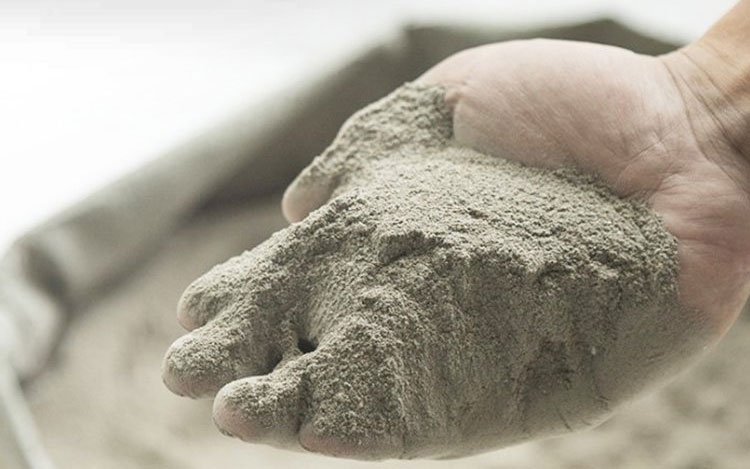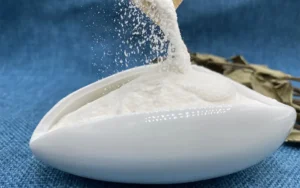
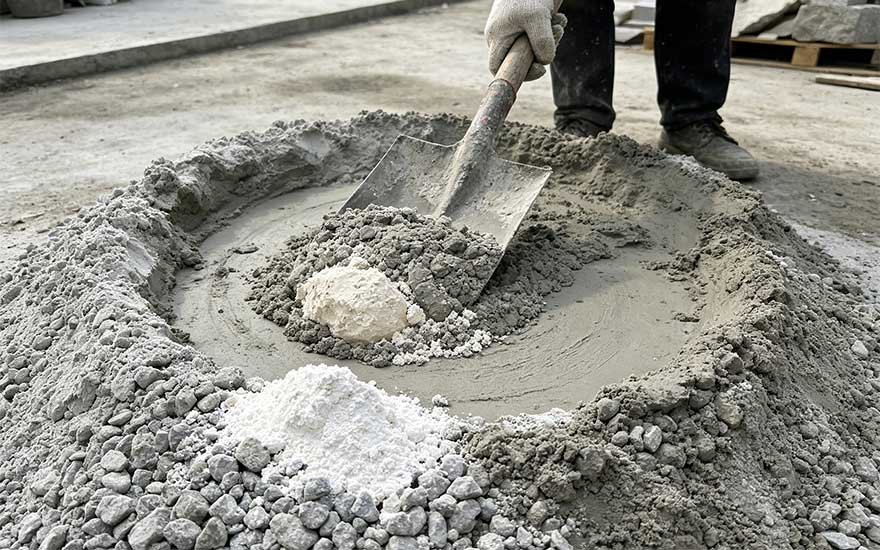

Michem Polycarboxylate Superplasticizer (PCE) Powder grade SP630 is a polycarboxylic ether-based high-range water reducer specifically formulated for dry-mix mortar and concrete applications using Portland cement. At a recommended dosage of 0.1–0.5% by weight of cementitious material, SP630 achieves a water reduction ratio exceeding 25%, with high-range performance reaching 35–45% water reduction under optimized mix designs. The powder format — with solid content ≥90% and moisture content ≤5% — enables homogeneous dry blending with cement, sand, and other dry-mix constituents without the dosing variability, shelf-life limitations, or transport complications associated with liquid admixtures.
The dispersion mechanism of SP630 is fundamentally different from legacy naphthalene-based or melamine-based superplasticizers. The polycarboxylic ether backbone provides dual-action dispersion through electrostatic repulsion and steric hindrance: the charged main chain adsorbs onto cement particle surfaces, while the grafted polyethylene oxide (PEO) side chains create a physical barrier that prevents particle agglomeration. This comb-type molecular architecture delivers superior dispersion at significantly lower dosages, outperforming naphthalene-based admixtures by approximately 2× in water reduction and 1.5× in compressive strength gain at 28 days. Per EN 934-2 (Admixtures for concrete — definitions and requirements) and ASTM C494 (Chemical Admixtures for Concrete), SP630 qualifies as a high-range water-reducing admixture, meeting the Type A (water-reducing) and Type F (high-range water-reducing) classification criteria respectively.
For dry-mix mortar manufacturers, the practical implication is substantial: a 35–45% reduction in mixing water at constant flow translates directly to a 30–50% gain in 28-day compressive strength, or alternatively, a significant reduction in cement content at equivalent strength — lowering both material cost and carbon footprint per unit of mortar produced.
Dry-mix mortar represents one of the largest application segments in construction chemicals, encompassing tile adhesives, masonry mortar, repair mortar, waterproofing mortar, and floor screeds. The global dry-mix mortar market demands consistent, factory-controlled product quality delivered in bagged or silo form, where every gram of admixture must disperse predictably upon reconstitution with water on site. Liquid admixtures — while effective in ready-mix concrete — introduce significant challenges in dry-mix production: they can cause cement pre-hydration during storage, complicate batch-to-batch homogeneity, and require specialized spraying equipment during production. PCE powder eliminates these issues entirely.
For mortar formulators and dry-mix plant operators, the choice of superplasticizer grade directly governs both production economics and field performance. Portland cement — the most widely used cementitious binder globally — has a well-characterized hydration chemistry and surface charge profile that responds optimally to PCE molecules with specific side-chain density and backbone length. SP630 is engineered with this Portland cement compatibility as its primary design criterion. Using a PCE grade designed for a different binder system (such as sulphoaluminate cement or gypsum) with Portland cement can result in rapid adsorption saturation, reduced dispersion efficiency, or even flash-setting — issues that the SP630 grade is specifically formulated to avoid.
The economic and sustainability implications are equally significant. With cement production accounting for approximately 7–8% of global CO₂ emissions, any admixture that enables cement reduction at equivalent strength directly contributes to lower-carbon construction. SP630’s 35–45% water reduction capacity allows formulators to achieve target strength at lower cement contents, or to exceed strength specifications at current cement contents — providing a commercially and environmentally superior alternative to naphthalene-based or lignosulfonate-based water reducers that have dominated the market for decades.

The superior performance of Michem PCE Powder SP630 stems from its comb-type molecular architecture. The molecule consists of a negatively charged polycarboxylic ether backbone with grafted polyethylene oxide (PEO) side chains of controlled length and density. When introduced into a cement-water system, two concurrent dispersion mechanisms operate:
Electrostatic repulsion: The anionic carboxylate groups on the backbone adsorb onto the positively charged calcium-rich sites on cement particle surfaces, particularly on the ettringite and C-S-H phases that form during early hydration. This adsorption imparts a net negative charge to the cement particles, creating an electrostatic repulsive force that drives particles apart and breaks up agglomerates. This mechanism is shared, in principle, with naphthalene-based and melamine-based superplasticizers.
Steric hindrance: The grafted PEO side chains extend outward from the adsorbed backbone into the surrounding solution, forming a hydrated polymer layer — or “steric layer” — around each cement particle. When two particles approach each other, these polymer layers overlap, generating a repulsive osmotic and entropic force that prevents close approach and agglomeration. This steric hindrance mechanism is unique to PCE-type superplasticizers and is the primary reason they achieve significantly higher dispersion efficiency than naphthalene-based admixtures, which rely solely on electrostatic repulsion.
The combination of these two mechanisms is what enables SP630 to achieve 35–45% water reduction — approximately double the water reduction of naphthalene-based superplasticizers — at a fraction of the dosage. In field validation of Portland cement dry-mix mortar formulations, SP630 at 0.3% dosage achieved flow values equivalent to control mixes at 0.6–0.8% naphthalene-based dosage, while simultaneously producing 1.5× the 28-day compressive strength gain.
Portland cement — composed primarily of C₃S, C₂S, C₃A, and C₄AF — presents a complex, dynamic surface chemistry during hydration. The C₃A phase hydrates rapidly, forming ettringite in the presence of gypsum, and creates a high surface area that aggressively adsorbs PCE molecules. If the PCE molecular structure is not optimized for this adsorption behavior, the admixture is consumed by the C₃A phase before it can effectively disperse the C₃S and C₂S phases that govern strength development.
SP630’s molecular design addresses this challenge through controlled side-chain density and backbone charge density that balances adsorption across all cement phases. The result is uniform dispersion of the entire cement particle distribution — not selective dispersion of only the early-hydrating phases. Site trials under EN/ASTM protocols confirm that Portland cement mortar formulated with SP630 at 0.2% dosage achieves a flow table spread of 180–200 mm per EN 1015-3 (Consistency of fresh mortar — flow table test) at a water-cement ratio 35–45% lower than a control mix without superplasticizer.
The relationship between water reduction and compressive strength gain in Portland cement systems follows a well-established inverse correlation with water-cement ratio. By reducing the mixing water required to achieve a target consistency, SP630 lowers the w/c ratio, which directly increases the density and strength of the hardened cement paste.
SP630 Dosage (% bwoc) | 减少用水量(%) | w/c Ratio Reduction | 28d Compressive Strength Gain (%) |
0.1 | 25-30 | 0.50 → 0.37 | 30–35 |
0.2 | 30–38 | 0.50 → 0.32 | 35–45 |
0.3 | 35-42 | 0.50 → 0.29 | 40–48 |
0.5 | 40–45 | 0.50 → 0.28 | 45–50 |
Note: Data is indicative, based on Portland cement (CEM I 42.5) mortar at baseline w/c = 0.50. Actual results vary with cement mineralogy, aggregate gradation, and ambient conditions. Strength gain per ASTM C109.
In our Technical Applications Team’s experience, the optimal dosage for most Portland cement dry-mix mortar applications falls in the 0.2–0.3% range, where the water reduction curve reaches its steepest slope before approaching the plateau region. Beyond 0.3–0.5%, diminishing returns in water reduction are typically observed, and excessive dosage may cause retardation of setting or air entrainment.
The powder format of SP630 — with solid content ≥90% and moisture content ≤5% — provides specific manufacturing advantages in dry-mix mortar production:
财产 | Michem PCE Powder Specification |
品牌 | Michem |
Product | Polycarboxylate Superplasticizer (PCE) Powder |
等级 | SP630 (for Portland cement dry-mix mortar and concrete) |
外观 | 白色至淡黄色粉末 |
组成 | 聚羧酸醚 |
扎实的内容 | ≥90% |
水分含量 | ≤5% |
减水率 | >25% (high-range: 35–45%) |
建议用量 | 0.1–0.5% by weight of cementitious material |
压缩强度增加(28d) | 30–50% |
保质期 | 2 年 |
Transport Classification | UN 3077 (non-hazardous for transport) |
Available Types | High-Range Water Reducer Powder, Low-VOC Eco-Friendly, Quick-Setting |
Performance vs. Naphthalene | 2× water reduction, 1.5× strength gain |
Source: Michem official technical specifications (michemicals.com).
应用 | 水泥类型 | Target Flow (EN 1015-3) | SP630 Dosage | Baseline w/c | Achieved w/c |
瓷砖粘合剂(C1) | CEM I 42.5 | 140–160 mm | 0.15–0.20% | 0.45 | 0.28–0.32 |
瓷砖粘合剂(C2) | CEM I 52.5 | 150–170 mm | 0.20–0.30% | 0.40 | 0.22–0.26 |
Masonry mortar (M5–M15) | CEM I 42.5 | 160–180 mm | 0.10–0.15% | 0.55 | 0.38–0.42 |
修补砂浆 | CEM I 52.5 | 170–190 mm | 0.25–0.35% | 0.40 | 0.22–0.26 |
Waterproofing mortar | CEM I 42.5 | 160–180 mm | 0.20–0.30% | 0.45 | 0.25–0.30 |
Floor screed (CT-C30-F4) | CEM I 42.5 | 140–160 mm | 0.15–0.25% | 0.50 | 0.28–0.35 |
步骤 | 动作 | Detail |
1 | Raw material inspection | Verify SP630 powder appearance (white to light yellow), moisture ≤5% |
2 | Sand drying | Reduce sand moisture to <0.5% before blending |
3 | Pre-blending | Mix sand + cement for 2–3 minutes in high-intensity mixer |
4 | Admixture addition | Add SP630 powder with other dry additives (HPMC, RDP, etc.) |
5 | Final mixing | Mix for 3–5 minutes until homogenous color and texture |
6 | Quality check | Sample and test flow per EN 1015-3; verify w/c ratio |
7 | 包装 | Pack in moisture-proof bags or silos; seal to maintain ≤5% moisture |
SP630 is fully compatible with standard dry-mix mortar additives. When formulating multi-additive systems, add SP630 alongside cellulose ethers (Michem HPMC) for water retention, MikaVAE® RDP for flexibility and adhesion, and TenaBrix® PP fibers for crack control. The order of addition in the dry mix does not affect SP630 performance, as the powder disperses upon water addition during site mixing.
检查 | 方法 | Acceptance Criterion |
Powder appearance | 视觉 | White to light yellow, free-flowing |
Flow consistency | EN 1015-3 flow table | Within ±10 mm of target |
Water reduction | Compare w/c vs. control at equal flow | ≥25% reduction |
凝固时间 | EN 480-2 (Vicat) | No excessive retardation (<120 min delay) |
28d 抗压强度 | ASTM C109 / EN 1015-11 | ≥30% gain over control at equal flow |
空气含量 | EN 1015-7 | ≤5% (unless air-entrained design) |
SP630’s powder format eliminates the risk of cement pre-hydration during storage, simplifies production (no liquid spraying equipment needed), achieves more precise dosing in automated plants, and provides a 2-year shelf life. Liquid admixtures are generally unsuitable for dry-mix mortar because they introduce moisture that can prematurely hydrate cement during bagged storage.
SP630 is formulated primarily for CEM I (Portland cement). It is compatible with CEM II (Portland-composite cement) and CEM III (blast furnace slag cement), though dosage may need adjustment due to the different surface area and adsorption characteristics of supplementary cementitious materials. Site trials per EN 934-2 are recommended to optimize dosage for specific blended cements.
Above 0.5% dosage, water reduction gains plateau and excessive PCE adsorption can cause significant setting retardation (extending initial set by 2–4 hours or more), increased air entrainment, and potential bleeding. If greater water reduction or strength is needed, consult the Michem Technical Applications Team for alternative formulation strategies rather than increasing dosage beyond the recommended range.
SP630 outperforms naphthalene-based superplasticizers by approximately 2× in water reduction (35–45% vs. 15–22%) and 1.5× in 28-day compressive strength gain (30–50% vs. 20–33%) at comparable dosage. Additionally, PCE does not produce the yellowish discoloration sometimes associated with naphthalene-based admixtures in light-colored mortars.
At the recommended dosage range (0.1–0.5%), SP630 does not significantly entrain air (typically <2% air entrainment). Workability retention is generally 30–60 minutes after water addition, which is sufficient for most dry-mix mortar applications. For extended open time, formulate with Michem HPMC cellulose ether to enhance water retention and workability.
Product data:
Standards cited:
Who it’s for: Dry-mix mortar formulators, construction chemicals R&D engineers, mortar plant production managers, and specification engineers selecting superplasticizer grades for Portland cement-based mortar and concrete products.
制作过程: Performance claims draw on Michem official product specifications (michemicals.com) and established EN/ASTM test protocols. Field-experience observations are drawn from the Michem Technical Applications Team’s concrete admixtures R&D work.
限制: Field results vary with local cement mineralogy, aggregate gradation, ambient climate, and complete mix design. The dosage ranges and performance figures given are indicative and must be validated with site trials under actual project conditions. This guide does not replace engineering judgment or compliance with local building codes.
更新政策: Reviewed annually, or whenever Michem product specifications or cited EN/ASTM standards are revised.
Michem PCE Powder grade SP630 delivers the high-range water reduction (35–45%), compressive strength gain (30–50% at 28 days), and Portland cement compatibility that dry-mix mortar manufacturers require for next-generation formulations. Its polycarboxylic ether comb-type molecule — providing dual electrostatic repulsion and steric hindrance — outperforms naphthalene-based alternatives by 2× in water reduction and 1.5× in strength gain, while the powder format (≥90% solid content, ≤5% moisture, 2-year shelf life) eliminates the production and storage challenges of liquid admixtures. Compliant with EN 934-2 and ASTM C494 Type A/F, SP630 is the engineered choice for Portland cement dry-mix mortar systems.

我是蒂娜,从事纤维素醚行业已有15年。我很乐意与大家分享这篇文章。如果您有任何好的建议,请告诉我。.
请联系我获取最新报价或申请样品测试(我们的样品是免费的,包括运费)。.
我们将在6小时内回复您的咨询。请提供您的设备类型和月处理量,以便为您提供定制报价。.
我们将及时为您提供专业的解决方案!
印度地区的咨询将在4小时内回复。请提供您的工厂类型和月产量,以便我们为您提供定制报价。.