
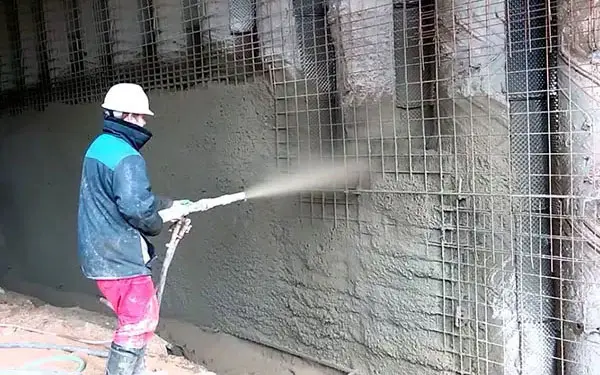
Polypropylene (PP) fiber has become an indispensable additive in tunnel shotcrete, addressing two critical failure modes:
This technical guide explains how PP fiber works in shotcrete, compares microfiber and macrofiber applications, and provides formulation data for tunnel lining compliance with EN 14488, ACI 506, and EFNARC guidelines.
Shotcrete applied to rock or existing concrete faces immediate moisture loss from:
Without fiber, plastic shrinkage cracks (typically 0.1–0.5 mm wide) form within 1–6 hours. These cracks:
PP microfibers at 0.6–1.0 kg/m³ effectively eliminate plastic shrinkage cracking by bridging micro-cracks at the initiation stage.
In transport tunnels (road, rail, metro), fire scenarios produce:
At around 200–300°C, the free water in concrete converts to steam faster than it can escape through the pore network. The steam pressure builds until the cover concrete explosively spalls — violent fragmentation that:
PP microfibers melt at 160–165°C, creating an interconnected pore network that allows steam to escape — completely eliminating explosive spalling even at sustained temperatures above 1,000°C. This phenomenon, unique to PP fiber, is now mandated in most tunnel fire safety codes globally.
| Fiber Type | Diameter | Length | Primary Function | Dosage |
|---|---|---|---|---|
| Monofilament Microfiber | 30–32 μm | 6–12 mm | Anti-spalling, plastic shrinkage control | 0.9–2.0 kg/m³ |
| Fibrillated Microfiber | 40–60 μm | 6–19 mm | Plastic shrinkage, secondary reinforcement | 0.6–1.2 kg/m³ |
| Macrofiber (structural) | 0.3–0.8 mm | 30–60 mm | Post-crack toughness, reduce steel fiber dosage | 3–8 kg/m³ |
| Combined (micro + macro) | Mixed | Mixed | Full performance spectrum | 1.0 + 4.0 kg/m³ |
TenaBrix PP Fiber Grades for Shotcrete:
| Grade | Type | Length | Diameter | Tensile Strength | Elastic Modulus | Recommended Use |
|---|---|---|---|---|---|---|
| PF-12M | Monofilament | 12 mm | 30–32 μm | ≥ 500 MPa | ≥ 4.5 GPa | Anti-spalling (fire), primary mix |
| PF-6F | Fibrillated | 6 mm | bundled | ≥ 500 MPa | ≥ 4.5 GPa | Plastic shrinkage reduction |
| PF-48MC | Macrofiber | 48 mm | 0.45 mm | ≥ 500 MPa | ≥ 4.5 GPa | Structural toughness enhancement |
Performance tested per EN 1363-2 (fire resistance) and EFNARC Spalling Test Protocol:
| Fiber Content | Fire Curve | Max Temperature | Spalling Observed? | Mass Loss (%) |
|---|---|---|---|---|
| 0 kg/m³ (control) | ISO 834 | 900°C | Explosive at 8 min | 18.5% |
| 0.9 kg/m³ PF-12M | ISO 834 | 900°C | None | 0.8% |
| 1.8 kg/m³ PF-12M | RWS (severe) | 1,200°C | None | 1.2% |
| 2.0 kg/m³ PF-12M | RABT (rail) | 1,200°C | None | 0.9% |
Substrate: C35/45 shotcrete, w/c = 0.42, OPC 52.5R, 23°C cure, 90 days age.
At 0.9 kg/m³ TenaBrix PF-12M, explosive spalling is completely eliminated under ISO 834 and RABT fire curves.
| Component | kg/m³ |
|---|---|
| OPC 52.5R Cement | 380–420 |
| Silica Fume | 30–40 |
| Fine Aggregate (0–4 mm) | 850–950 |
| Coarse Aggregate (4–8 mm) | 350–450 |
| Water | 165–180 |
| PCE Superplasticizer | 4–6 |
| Accelerator (alkali-free) | 25–35 |
| TenaBrix PP Fiber PF-12M | 0.9–1.5 |
w/c = 0.40–0.45 | Slump flow: 200–250 mm (wet mix) | 1-day compressive strength: ≥ 12 MPa | 28-day: ≥ 35 MPa
| Component | kg/m³ |
|---|---|
| OPC 52.5R Cement | 420–460 |
| Fly Ash (Class F) | 40–60 |
| Silica Fume | 30–40 |
| Fine Aggregate | 800–900 |
| Water | 155–170 |
| PCE Superplasticizer | 5–8 |
| Accelerator (alkali-free) | 30–40 |
| TenaBrix PP Fiber PF-12M | 1.5–2.0 |
| Steel Fiber (hooked-end, 35mm) | 20–30 (optional) |
Designed to meet EN 1992-1-2 fire exposure class EI120 | Residual strength class: EN 14487-1 Class B500
Many modern tunnel projects use a hybrid fiber system to reduce steel fiber content while maintaining structural toughness:
| System | Steel Fiber | PP Fiber | Cost Impact | Performance |
|---|---|---|---|---|
| Steel fiber only (reference) | 35 kg/m³ | 0 | 100% | EN 14488 Class 5 |
| Steel + PP hybrid | 20 kg/m³ | 2 kg/m³ PF-48MC | ~75% | EN 14488 Class 5 |
| PP macrofiber only | 0 | 7 kg/m³ PF-48MC | ~55% | EN 14488 Class 3–4 |
The hybrid approach reduces rebound losses (steel fiber bounces back; PP fiber has near-zero rebound) and decreases total material cost by 20–30%.
A critical advantage of PP fiber over steel fiber:
| Standard | Requirement | TenaBrix PF Grade |
|---|---|---|
| EN 14487-1 (Shotcrete) | Fiber-reinforced shotcrete classification | PF-12M, PF-48MC |
| EN 14488-5 (Toughness) | Energy absorption ≥ 700 J (Class 5) | PF-48MC at 6–8 kg/m³ |
| EN 1363 / EFNARC | Anti-spalling ≥ 0.9 kg/m³ PP microfiber | PF-12M |
| ACI 506R (USA) | Wet-mix shotcrete fiber reinforcement | PF-12M, PF-6F |
| JSCE-SF4 (Japan) | Toughness factor TF ≥ 30 | PF-48MC |
| IS 9012 (India) | Shotcrete for underground works | PF-12M, PF-6F |