
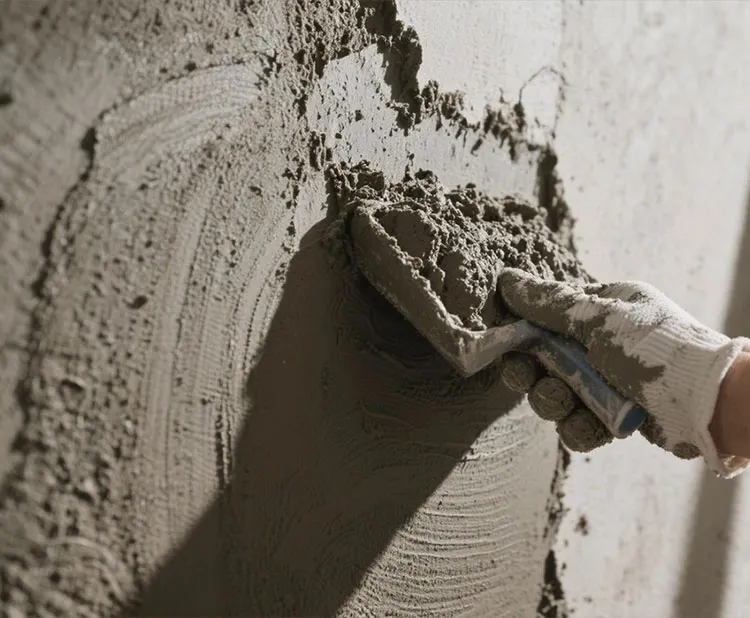
Plastic shrinkage cracking occurs during the first 0–8 hours after mortar placement, while the mix is still in a semi-fluid “plastic” state. It is distinct from drying shrinkage cracking (which occurs days to weeks later).
Mechanism:
Evaporation risk chart:
| Temperature | Wind Speed | Relative Humidity | Evaporation Rate | Risk Level |
|---|---|---|---|---|
| 25°C | 5 km/h | 70% | ~0.2 kg/m²/h | Low |
| 35°C | 10 km/h | 40% | ~0.8 kg/m²/h | High |
| 40°C | 20 km/h | 20% | ~2.0 kg/m²/h | Critical |
| 45°C | 30 km/h | 15% | ~3.0+ kg/m²/h | Extreme |
In Saudi Arabia and UAE during summer, evaporation rates of 1.5–3.0 kg/m²/hour are common on south-facing facades — creating near-impossible conditions for plain mortar.
Polypropylene microfibers work through three physical mechanisms:
PP fibers at 3–6 mm length are randomly distributed throughout the mortar matrix at densities of 50–150 million fibers per cubic meter. When a micro-crack begins to propagate:
Capillary bleed channels form as water migrates upward in fresh mortar. PP fibers physically disrupt these channels, distributing the capillary tension into many small pathways rather than concentrating it in discrete crack planes.
Even if micro-cracks do form, PP fibers increase the crack bridging capacity, limiting crack width to <0.1 mm (vs. 0.3–2.0 mm in unreinforced mortar). Narrow cracks are visually acceptable and structurally harmless.
Not all PP fibers are equal. Mortar and plaster applications use monofilament microfibers, which are fundamentally different from structural macro-fibers used in slabs or tunnels.
| Property | Value | Test Method |
|---|---|---|
| Material | Polypropylene (100%, virgin grade) | — |
| Form | Individual filaments (not bundles) | Visual |
| Fiber length | 3 mm or 6 mm | Direct measure |
| Diameter | 12–18 μm | Optical microscopy |
| Tensile strength | ≥ 450 MPa | ISO 1924-2 |
| Elastic modulus | 3,500–4,500 MPa | ISO 1924-2 |
| Elongation at break | 15–25% | ISO 1924-2 |
| Density | 0.91 g/cm³ | ISO 1183 |
| Melting point | 160–165°C | DSC |
| Alkali resistance | Excellent | pH 13+ 28d immersion |
| Acid resistance | Excellent | — |
| Dispersion in water | Excellent (individual filaments) | 5-min mix test |
| Application | Recommended Length | Reason |
|---|---|---|
| Thin plaster (3–8 mm) | 3 mm | Short fibers distribute without protruding through surface |
| Standard render (8–20 mm) | 3–6 mm | Either works; 6 mm for heavier mixes |
| Thick base coat (>20 mm) | 6 mm | More bridging length for thicker applications |
| Machine-applied plaster | 3 mm | Reduces pump wear and blockage risk |
| Hand-applied render | 3–6 mm | Both acceptable; 6 mm for better workability “feel” |
PP fiber dosage for mortar/plaster is measured in kg/m³ of fresh mix (not % of dry powder).
| Application | Dosage (kg/m³) | Equivalent (% dry powder) | Expected Crack Reduction |
|---|---|---|---|
| Interior plaster (temperate) | 0.6–0.8 | 0.05–0.07% | 40–60% |
| Exterior render (temperate) | 0.8–1.0 | 0.07–0.09% | 60–75% |
| Exterior render (hot climate) | 1.0–1.5 | 0.09–0.13% | 75–90% |
| EIFS base coat | 0.8–1.2 | 0.07–0.10% | 70–85% |
| Machine-applied plaster | 0.6–1.0 | 0.05–0.09% | 60–75% |
| Repair mortar | 1.0–1.5 | 0.09–0.13% | 75–85% |
Hot-climate rule of thumb: In Saudi Arabia, UAE, and western India (summer conditions), use the upper end of the dosage range and add HPMC (0.2–0.3%) to slow surface drying simultaneously.
| Component | Parts by Weight | Notes |
|---|---|---|
| Portland cement (CEM II 32.5R) | 25–30 | Binder |
| Hydrated lime | 3–7 | Workability, shrinkage reduction |
| Quartz sand (0.1–1.0 mm) | 55–65 | Aggregate |
| Calcium carbonate (filler) | 3–8 | Filler |
| HPMC (20,000–40,000 mPa·s) | 0.20–0.35 | Water retention, open time |
| PP monofilament fiber (3–6 mm) | 0.08–0.12 | Crack prevention |
| RDP (VAE polymer powder) | 1.5–3.0 | Adhesion, flexibility |
| Hydrophobic agent | 0.2–0.4 | Water repellency |
Target performance:
| Method | Effectiveness | Cost Impact | Ease of Use | Limitations |
|---|---|---|---|---|
| PP microfiber (0.1%) | High (75–90%) | Low (+1–2%) | Simple (add to mixer) | Must disperse fully |
| Polypropylene mesh overlay | Medium | High (+15–25%) | Complex (2-step) | Labor intensive |
| Increased HPMC dosage only | Low-Medium (30–50%) | Low | Simple | Reduces strength |
| Curing membrane | Medium (40–60%) | Medium | Extra step | Doesn’t prevent early cracks |
| Shade + fogging | Medium (50–70%) | Site-dependent | Site logistics | Impractical for large facades |
| PP fiber + HPMC combo | Very High (85–95%) | Low (+2–3%) | Simple | Best for hot climate |
1. Mixing sequence matters Add PP fibers to the dry mix BEFORE adding water. Pre-blending in dry state ensures individual fiber dispersion. Adding to wet mix can cause fiber balling.
2. Mixing time Minimum 3 minutes in a forced-action mixer (paddle mixer). Drum mixers need 5+ minutes. Verify no fiber clumps are visible before application.
3. Apply in the cooler part of the day In Middle East summer, apply between 5:00–9:00 AM or after 5:00 PM. Avoid direct midday sun on fresh plaster.
4. Protect from wind Wind increases evaporation as much as temperature. Temporary windbreak screens on scaffolding can reduce crack incidence by 30–40%.
5. Wet curing (if accessible) Light water misting of fresh render after initial set (60–90 minutes) significantly reduces drying shrinkage cracks.
6. Layer thickness Apply render in maximum 15 mm single coats. Thick single applications increase cracking risk regardless of fiber content.