
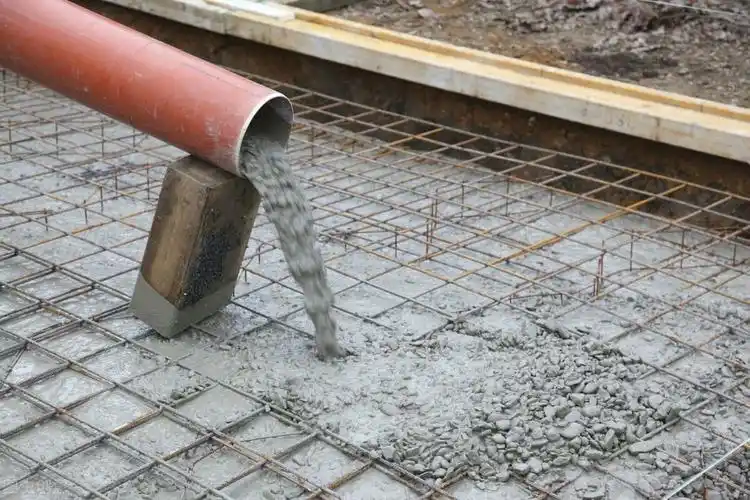
RMC is not standard site-mixed concrete. The logistical demands are unique:
| RMC Challenge | Consequence Without PCE |
|---|---|
| 30–90 min transport time | Slump loss → on-site water addition → strength failure |
| High-strength spec (C30–C50) | Requires low w/c (≤0.45) → low workability without admixture |
| Pumping to upper floors | Needs S4 (180–210 mm) slump for pump pressure |
| Hot weather (35–45°C) | Accelerated cement hydration → rapid slump loss |
| SCM use (fly ash, slag) | Different water demand → needs flexible admixture |
PCE superplasticizer addresses all five challenges simultaneously.
PCE (polycarboxylate ether) is a comb polymer with:
This dual mechanism provides:
| Property | Naphthalene/Lignosulfonate | PCE Superplasticizer |
|---|---|---|
| Water reduction rate | 10–15% | 20–30% |
| Slump retention (60 min) | 30–50% of initial | 70–90% of initial |
| Dosage required | 0.5–1.5% | 0.15–0.5% |
| Compatibility with SCM | Limited | Excellent |
| Compatible with retarders | Yes | Yes (with care) |
| Air entrainment effect | Moderate increase | Low (controllable) |
| Set retardation | Minimal | Slight (adjustable) |
Without PCE: Cement particles clump into flocs, trapping mix water inside. Effective w/c at particle level is low even with high total water content.
With PCE: Steric repulsion disperses cement particles completely. All mix water becomes “free water” for lubrication. Result: same workability at 20–30% less water, or dramatically higher workability at same water content.
Target for RMC:
PCE dosage to achieve S4 from base mix: Typically 0.15–0.35% by weight of cement (varies by cement type, SCM content, and mix design).
The most critical RMC parameter. PCE retention profile must match haul time.
| PCE Type | 30 min retention | 60 min retention | 90 min retention | Application |
|---|---|---|---|---|
| Standard PCE | 85–90% | 65–75% | 45–60% | Short haul <30 min |
| Slow-release PCE | 90–95% | 80–90% | 70–80% | Standard RMC |
| SCC-grade PCE | 95%+ | 88–95% | 80–90% | SCC, deep pours |
Tenabrix recommendation for GCC and India RMC: Use slow-release PCE (ether chain length > 45 EO units) to ensure ≥70% slump retention at 60 minutes in 35–40°C ambient conditions.
| Target w/c | Base mix w/c (no admixture) | PCE water reduction needed | PCE dosage |
|---|---|---|---|
| ≤ 0.45 (C35) | 0.55 | ~18% | 0.15–0.20% |
| ≤ 0.40 (C40) | 0.55 | ~27% | 0.25–0.35% |
| ≤ 0.35 (C50) | 0.55 | ~36% | 0.35–0.50% |
PCE follows a characteristic saturation curve:
How to determine saturation dose (plant trial protocol):
| Cement Type | SCM | Temperature | Saturation Dose Range |
|---|---|---|---|
| CEM I 52.5R | None | 25°C | 0.20–0.30% |
| CEM I 42.5N | 20% fly ash | 25°C | 0.18–0.25% |
| CEM I 42.5R | 30% GGBS | 30°C | 0.22–0.32% |
| Blended cement (OPC+PPC) | — | 35°C | 0.25–0.40% |
| OPC (Indian BIS 53 grade) | 25% fly ash | 38°C | 0.28–0.45% |
India’s RMC market exceeds 300 million m³/year and is growing rapidly. Specific considerations:
Studies show that adding PCE after dry cement-aggregate mixing (delayed addition) can improve slump retention by 10–15% versus early addition. Protocol:
| Admixture Combination | Compatibility | Note |
|---|---|---|
| PCE + calcium formate | ✅ Good | Formate accelerates set; PCE retards slightly — balanced |
| PCE + air-entraining agent | ⚠️ Caution | Test for excessive air; some PCE grades are air-entraining |
| PCE + retarder (gluconate) | ✅ Good | Standard combination for hot-climate long-haul |
| PCE + shrinkage-reducing agent (SRA) | ✅ Good | Complementary; no interaction |
| PCE + accelerator (calcium chloride) | ❌ Avoid | Potential precipitation; use calcium formate instead |
| Parameter | Without PCE | With PCE (0.25%) | Difference |
|---|---|---|---|
| Mix water | 195 L | 145 L | −50 L |
| Cement content | 380 kg | 320 kg | −60 kg |
| Slump at 60 min | ~80 mm | ~165 mm | +85 mm |
| 28d compressive strength | 38 MPa | 45 MPa | +7 MPa |
| On-site water additions | Frequent | None | — |
| PCE cost addition | — | ~$2.50–4.00/m³ | — |
| Cement cost saving | — | ~$5.00–8.00/m³ | — |
| Net saving | — | ~$2–4/m³ | Positive ROI |
PCE is not an added cost — it is a cement replacement strategy that pays for itself.