
PAN (Polyacrylonitrile) fiber is essential for fire-resistant concrete panels because it maintains structural integrity at temperatures ≥200°C — far exceeding PP fiber’s melting point of 160°C. In fire-rated panels, PAN fiber continues to bridge micro-cracks and restrain explosive spalling even under sustained thermal exposure, preventing catastrophic panel failure.
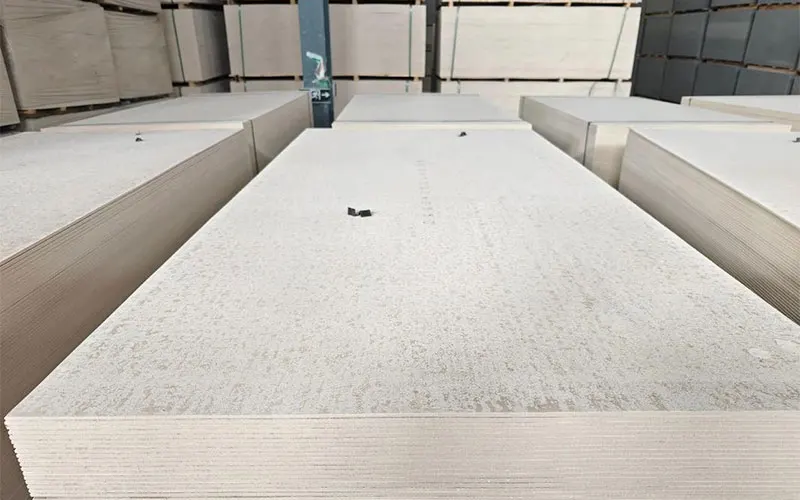
The mechanism is straightforward: when concrete panels are exposed to fire, internal moisture vaporizes rapidly, generating pore pressures that can exceed the concrete’s tensile strength. This triggers explosive spalling — chunks of concrete violently detach from the surface, exposing reinforcement and accelerating structural collapse. Polypropylene (PP) fibers melt at 160°C, creating temporary channels for vapor escape. But above that temperature, PP fibers are gone. PAN fiber does not melt. With a heat resistance of ≥200°C and an elastic modulus of ≥4000 MPa, PAN fiber remains physically intact and mechanically active throughout the fire event. It continues bridging micro-cracks, restraining crack propagation, and preserving the panel’s load-bearing capacity long after PP fiber has disappeared.
For architects, engineers, and precast panel manufacturers, this translates directly to: longer fire-resistance ratings, reduced spalling risk in high-performance concrete (HPC), and compliance with increasingly stringent fire safety codes. In short, PAN fiber isn’t just an additive — it’s the thermal backbone of fire-rated concrete panels.
Fire safety is not negotiable in modern construction. Building codes globally — from the International Building Code (IBC) to Eurocode 2 (EN 1992-1-2) and China’s GB 50016 — mandate fire-resistance ratings for structural elements, including precast concrete panels. The difference between a panel that resists fire for 60 minutes versus 120 minutes can determine life safety outcomes and regulatory compliance.
Tunnel fires provide stark illustration. The 1999 Mont Blanc Tunnel fire reached temperatures above 1,000°C and lasted 53 hours. The 2008 Channel Tunnel fire similarly demonstrated how explosive spalling can devastate concrete linings. In both cases, panels without adequate fiber reinforcement experienced severe spalling, exposing structural steel to direct flame impingement. Post-incident investigations repeatedly identified inadequate spalling protection as a critical failure mode.
The commercial consequence is equally significant. Fire-rated precast panels command premium pricing in markets from the Middle East to Southeast Asia, where high-rise construction demands proven fire performance. Specifying PAN fiber at the mix design stage is a cost-effective insurance policy: the material cost increment is marginal compared to the liability of spalling failure. For manufacturers competing on fire ratings, PAN fiber is a competitive necessity, not an optional upgrade.
PAN fiber’s fire performance originates in its polymer structure. The polyacrylonitrile backbone undergoes cyclization — not melting — when heated. Above approximately 200°C, the nitrile groups (-C≡N) in PAN begin converting to a ladder polymer structure through intramolecular cyclization. This transformation releases minimal volatiles and forms a thermally stable carbonaceous residue. Unlike PP, which undergoes endothermic melting at 160°C and completely liquefies, PAN fiber remains solid, dimensionally stable, and mechanically functional.
The critical distinction is: PAN fiber creates permanent, three-dimensional reinforcement within the concrete matrix that persists across the entire fire temperature range relevant to structural design. Where PP fiber leaves empty channels (useful for initial vapor release but structurally void after melting), PAN fiber maintains crack-bridging action continuously.
Explosive spalling results from the convergence of three mechanisms during fire exposure:
PAN fiber addresses all three mechanisms. Its high elastic modulus resists crack opening under tensile stress. Its thermal stability ensures this resistance persists above 200°C. And its dispersion throughout the matrix creates a three-dimensional reinforcement network that constrains spalling regardless of the stress origin.
While standard fire curves (ISO 834, ASTM E119) reach 1,000°C within 90 minutes, the critical window for fiber performance is 100-300°C — the temperature range where spalling initiates. Published research on PAN fiber-reinforced HPC demonstrates:
Property | PAN Fiber (Michem) | PP Fiber (TenaBrix®) |
Heat resistance | ≥200°C (no melting) | 160°C (melts completely) |
Behavior at 180°C | Solid, mechanically active | Liquefied, structurally absent |
Mechanism | Continuous crack bridging | Temporary vapor channels only |
Post-fire residual effect | Char layer with residual strength | Empty channels, no reinforcement |
Suitable for | Fire-rated panels, tunnels, HPC | General plastic shrinkage control |
Property | PAN Fiber (Michem) | Steel Fiber |
Thermal conductivity | Low (does not conduct heat inward) | High (conducts heat to reinforcement) |
Corrosion risk | None (inherently non-corrosive) | Moderate to high after fire exposure |
Weight addition | Negligible | Significant (7850 kg/m³) |
Spalling prevention | Direct crack bridging + low conductivity | Mixed — can accelerate internal heating |
Electromagnetic transparency | Fully transparent | Interferes with EM signals |
The low thermal conductivity of PAN fiber is a significant advantage over steel fiber in fire scenarios. Steel fibers can act as thermal bridges, conducting surface heat deeper into the panel cross-section and accelerating internal temperature rise. PAN fiber’s polymeric nature insulates rather than conducts, containing thermal damage to the surface layers.
Parameter | Specification |
Material | 100% Polyacrylonitrile (PAN) |
Diameter | 14-18 μm |
Length options | 3 mm / 6 mm / 12 mm / 18 mm |
Tensile strength | ≥500 MPa |
Elastic modulus | ≥4,000 MPa |
Heat resistance | ≥200°C |
Density | ~1.18 g/cm³ |
Appearance | Light yellow, monofilament |
Acid/Alkali resistance | Excellent |
Dispersion | Uniform in concrete mix |
Type | Tensile Strength | Key Feature | Recommended Application |
High-Modulus | ≥800 MPa | Superior crack restraint | Structural fire-rated panels, high-rise façades |
Alkali-Resistant | ≥750 MPa | Coated for alkaline environments | Precast panels with extended curing, aggressive exposure |
Short-Cut | ≥700 MPa | Optimized for pumpability and dispersion | Sprayed concrete, thin panels, tunnel linings |
Parameter | Specification |
Material | 100% Polypropylene |
Diameter | 30-32 μm |
Tensile strength | ≥500 MPa |
Elastic modulus | ≥4,500 MPa |
Melting point | 160°C |
Density | 0.91 g/cm³ |
The optimal PAN fiber dosage depends on the target fire-resistance rating and concrete mix design:
Fire Rating Target | PAN Fiber Dosage | Fiber Length | Panel Type |
60 minutes | 0.9-1.2 kg/m³ | 6 mm | Interior partition panels |
90 minutes | 1.2-1.5 kg/m³ | 6-12 mm | Exterior façade panels |
120 minutes | 1.5-2.0 kg/m³ | 12-18 mm | Structural load-bearing panels, tunnel segments |
Cement content: Maintain 380-450 kg/m³ for standard fire-rated panels. Higher cement contents above 500 kg/m³ increase spalling risk and require elevated PAN fiber dosages of 1.5-2.5 kg/m³.
Water-cement ratio: Target 0.35-0.40 for HPC fire-rated panels. Lower w/c ratios produce denser matrices with higher spalling susceptibility — precisely the scenario where PAN fiber provides maximum benefit.
Aggregate selection: Calcareous aggregates (limestone, dolomite) provide better fire performance than siliceous aggregates due to higher thermal decomposition temperatures and endothermic calcination reactions. Combined with PAN fiber, calcareous aggregate mixes achieve the best spalling resistance.
Silica fume / supplementary materials: Silica fume additions of 5-10% increase matrix density and spalling risk. When silica fume is specified for strength requirements, increase PAN fiber dosage by 0.3-0.5 kg/m³ to compensate.