
How to Make Mortar Inherently Water-Repellent: Silicone Hydrophobic Powder Dosage & Mechanism

Introduction

Adding 0.1%–1.0% silicone hydrophobic powder to mortar formulations creates inherent water repellency throughout the entire material matrix, fundamentally different from surface-applied sealers that form only a temporary film on the exterior. The silicone-based active ingredient disperses uniformly during mixing and reacts with cement hydration products to form hydrophobic nano-layers on capillary pore walls. These nano-layers reduce the surface energy of the pore structure, increasing the contact angle between water and pore walls so that liquid water cannot penetrate — while still permitting water vapor diffusion so the mortar “breathes.”

Table of Contents

Silicone-Hydrophobic-Powder-to-Make-Mortar-Inherently-Water

This integral waterproofing approach means that even if the surface is scratched, abraded, or weathered, the water repellency persists because the active ingredient is distributed throughout the cross-section. Typical dosage ranges from 0.1% for mild moisture resistance in interior plasters to 1.0% for aggressive exterior waterproofing applications such as basement retaining walls, bridge deck overlays, and marine structures. The powder format eliminates shelf-life instability and handling hazards associated with liquid silanes/siloxanes, while delivering equivalent or superior hydrophobic performance at lower total application cost.

Key Takeaways

  • Dosage range: 0.1%–1.0% by weight of cementitious binder, with most exterior waterproofing applications optimized at 0.3%–0.5%
  • Inherent vs. surface treatment: Unlike film-forming sealers, silicone hydrophobic powder integrates through the entire mortar matrix — scratch, chip, or abrade the surface and water repellency remains intact
  • Bulk density: 300–600 g/L, enabling easy handling, metering, and dispersion in standard dry-mix blending equipment
  • Broad compatibility: Suitable for cement-based mortars, plasters, grouts, tile adhesives, putties, and waterproofing slurry systems
  • Breatheability preserved: Repels liquid water while maintaining water vapor permeability, preventing trapped moisture that causes freeze-thaw spalling and internal degradation

Why This Answer Matters

Surface-applied waterproofing treatments — silane/siloxane sprays, acrylic coatings, bituminous membranes — all share the same fatal flaw: they exist only on the surface. In construction, surfaces get damaged. Mortar joints get tooled. Plaster gets scratched. Coatings weather, crack, and delaminate. When this happens, water finds a path in, and the “waterproofing” fails at precisely the point where it is needed most.

Integral waterproofing with silicone hydrophobic powder solves this at the root cause. By distributing the hydrophobic agent through the entire material volume during mixing, every capillary pore — from the exposed face to the core — becomes water-repellent. This is particularly critical in applications subject to mechanical wear (industrial floors), crack formation (structural repair mortars), or continuous hydrostatic pressure (basements below the water table).

The economic argument is equally compelling. A single powder addition during batching replaces post-cure surface treatment operations, eliminates re-application cycles every 5–10 years, and reduces call-back risk for waterproofing failures. For formulators and pre-mix manufacturers, silicone hydrophobic powder is not a cost — it is a value-differentiation tool that transforms commodity mortar into a premium, performance-engineered product.

Technical Deep Dive

The Chemistry of Silicone Hydrophobicity

Silicone hydrophobic powder contains an organosilicon active compound — structurally similar to polydimethylsiloxane (PDMS) backbones with functional alkoxy or silanol groups. When introduced into a cementitious mix, these functional groups undergo hydrolysis and condensation reactions in the highly alkaline pore solution (pH 12–13) created by cement hydration:

  1. Hydrolysis: Alkoxy groups (–OR) are hydrolyzed to silanol groups (–Si–OH) in the presence of water and alkali.
  1. Condensation: Silanol groups condense with hydroxyl groups present on hydrated cement phases (C–S–H gel, portlandite surfaces) forming stable –Si–O–Si– and –Si–O–Ca– covalent bonds.
  1. Orientation: The non-polar methyl (–CH₃) groups of the siloxane backbone orient outward from the pore surface, creating a low-energy hydrophobic interface.

How It Works Within the Cement Matrix

The critical differentiator is the spatial distribution of the hydrophobic treatment. Unlike surface sealers that penetrate only 2–5 mm into cured concrete via capillary suction, the powder disperses as micro-particulates during mixing. As hydration proceeds, each particle becomes a nucleation site for hydrophobic modification of the surrounding cement gel.

The result is a three-dimensional network of water-repellent surfaces lining the interconnected capillary pore system. The contact angle of water on treated pore walls typically exceeds 110°, meaning the capillary pressure actually repels water rather than drawing it in. The Young-Laplace equation governs this behavior:

ΔP = 2γ cosθ / r

Where ΔP is capillary pressure, γ is water surface tension, θ is the contact angle, and r is the pore radius. For untreated cement (θ ≈ 30°), cosθ is positive and water is drawn into pores. For silicone-treated pores (θ > 90°), cosθ becomes negative, and capillary pressure actively resists water ingress.
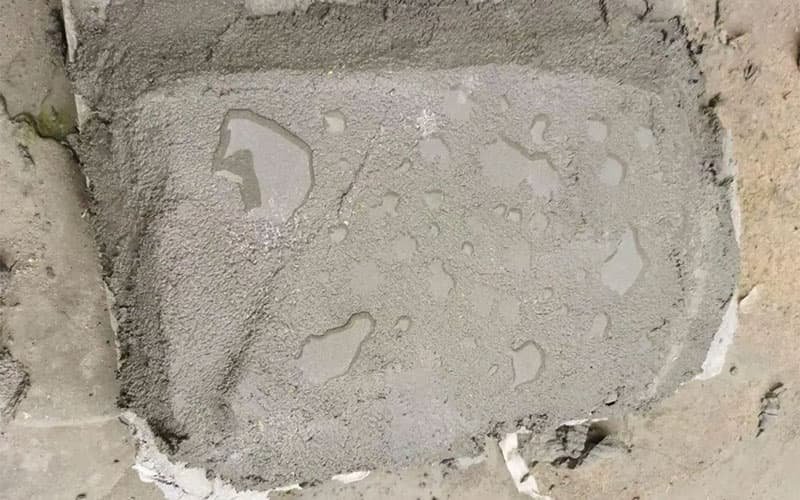
SHP mortar-for-waterproof

Capillary Pore Treatment Depth

In a properly formulated mix, the hydrophobic effect extends from the outer surface through the full thickness. SEM-EDS analysis of fractured mortar specimens confirms silicon enrichment evenly distributed across the cross-section, not merely concentrated at the surface. This is the fundamental advantage that makes integral hydrophobicity superior for long-term durability.

Comparison with Liquid Silanes/Siloxanes

Liquid silane treatments (alkyltrialkoxysilanes such as isobutyltrimethoxysilane or octyltriethoxysilane) are effective surface treatments but carry significant practical limitations:

Parameter

Liquid Silane (Surface)

Michem Silicone Powder (Integral)

Application stage

Post-cure (28 days minimum)

During mixing

Distribution depth

2–5 mm maximum

Full cross-section

Weather dependency

Requires dry surface, no rain forecast

None

VOC content

Often solvent-borne (high VOC)

Zero VOC, dry powder

Surface damage tolerance

Lost if surface abraded

Maintained regardless of surface condition

Shelf life

6–12 months, moisture-sensitive

Extended, stable powder form

Worker exposure risk

Solvent inhalation, skin contact

Minimal dust hazard (standard PPE)

Dosage Optimization by Capillary Porosity

The required dosage correlates directly with the water-cement ratio and resultant capillary porosity. Low w/c ratio mortars (w/c < 0.40) with inherently low porosity may achieve target water absorption values at 0.2% dosage. Higher w/c mixtures (w/c > 0.55) or those containing lightweight aggregates with higher porosity demand doses toward the upper end of the 0.5%–1.0% range.

Product Specifications

Property

Value

Product Name

Michem Silicone Hydrophobic Powder

Appearance

White to off-white free-flowing powder

Active Ingredient

Silicone-based hydrophobic compound

Bulk Density

300–600 g/L

Moisture Content

≤ 5%

pH

Neutral to slightly alkaline

Recommended Dosage

0.1%–1.0% by weight of cementitious binder

Primary Applications

Mortar, plaster, grout, tile adhesive, wall putty, waterproofing systems

Packaging

Available in multi-layer paper bags or bulk sacks

All values are typical and based on current production specifications. Contact Michem for certificate of analysis for your specific lot.

Practical Application Guide

Dosage Calculator

The dosage is always calculated as a percentage of the total cementitious binder weight, not total mix weight. This includes cement plus any supplementary cementitious materials (fly ash, slag, silica fume).

Formula:

Powder mass (kg) = Cementitious binder (kg) × Dosage (%)

Worked Examples:

Application

Binder (kg/m³)

Dosage (%)

Powder Required (kg/m³)

Interior wall putty

150

0.15%

0.23

Exterior render/plaster

300

0.3%

0.90

Tile adhesive (C2)

350

0.3%

1.05

Waterproofing slurry

400

0.5%

2.00

Structural repair mortar

450

0.5%

2.25

Basement tanking mortar

500

1.0%

5.00

Mix Design Example: Exterior Water-Repellent Render

Component

Parts by Weight

kg per 1000 kg batch

OPC CEM I 42.5

100

250

Limestone filler

30

75

Graded silica sand (0.1–1.0 mm)

300

750

Cellulose ether (viscosity modifier)

0.15

0.38

Michem Silicone Hydrophobic Powder

0.15 (0.5% of binder)

1.25

Polypropylene fiber (optional)

0.10

0.25

Water (adjust to consistency)

~55

~138

Target Properties:

  • 24h capillary water absorption (EN 1015-18): < 0.20 kg/(m²·min^0.5)
  • Water vapor permeability (EN 1015-19): μ < 15
  • Compressive strength (28d): Class CS III–CS IV

Mixing Procedure

  1. Pre-blend Michem Silicone Hydrophobic Powder with a portion of the fine aggregate or filler to ensure even distribution.
  1. Add all dry components (cement, aggregates, admixtures, pre-blended powder) to the mixer and homogenize for 2–3 minutes.
  1. Add water gradually while mixing. The hydrophobic powder does not significantly affect water demand; adjust to target consistency.
  1. Mix for an additional 3–5 minutes after water addition to ensure complete dispersion.
  1. Apply following standard good practice for the mortar type. No special curing regime is required — standard moist curing is recommended.

Quality Control Tests

  • Karsten tube test (on-site, 24h): Water absorption should be negligible compared to untreated control
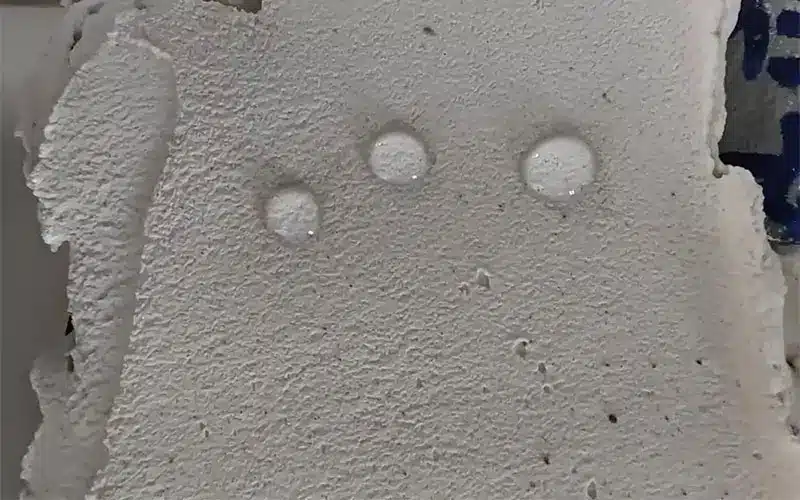
  • Drop test: Water droplets should bead on the cured surface with a high contact angle
  • Capillary absorption (EN 1015-18 / ASTM C1585): Quantify reduction vs. untreated reference
  • Compressive strength: Verify ≤ 10% change vs. untreated reference (typically within 5%)

Frequently Asked Questions

No. At recommended dosages (0.1%–1.0%), the effect on compressive strength is typically within ±5% of the untreated control. The hydrophobic modification occurs on pore surfaces and does not significantly disrupt the cement hydration or C–S–H gel formation. In some formulations, slight strength improvements are observed due to reduced evaporation and improved internal curing.

Dosages above 1.0% are not recommended for cementitious systems. Beyond this threshold, the hydrophobic effect plateaus while workability, adhesion, and mechanical properties may begin to deteriorate. For extreme conditions such as sustained hydrostatic pressure, combine integral hydrophobicity with a dense-graded mix design and supplementary cementitious materials.

Yes. It is compatible with cellulose ethers, polycarboxylate superplasticizers, redispersible polymer powders (RDP), accelerators, retarders, air-entraining agents, and PP fibers. Always conduct compatibility trials when combining multiple admixtures, particularly at the upper end of dosage ranges, as competitive adsorption effects can occasionally occur.

Stearate-based water repellents function by a different mechanism — they form insoluble calcium salts that physically block pores. While effective at higher dosages (1%–3%), they can significantly reduce strength and do not provide the same nano-scale surface modification. Silicone-based hydrophobicity typically achieves equivalent or better water repellency at 50%–70% lower dosage with less impact on mechanical properties.

Store in original sealed packaging in a cool, dry environment away from direct sunlight. Under recommended storage conditions (temperature < 35°C, relative humidity < 65%), shelf life exceeds 12 months from the date of manufacture. Once opened, re-seal tightly and consume promptly. The powder should remain free-flowing; clumping may indicate moisture exposure and should trigger quality verification before use.

Conclusion

Silicone hydrophobic powder represents a step-change in construction waterproofing — shifting protection from a fragile surface layer to an inherent property of the material itself. At 0.1%–1.0% dosage, Michem Silicone Hydrophobic Powder transforms ordinary cementitious mortars, plasters, grouts, and putties into water-repellent systems that maintain performance through decades of weathering, abrasion, and structural movement.

For formulators seeking to differentiate product lines with premium waterproofing performance without the complexity of multi-step installation or the call-back risk of surface treatments, integral silicone hydrophobic powder is the technically sound and commercially strategic choice.

Your Reliable Partner For Cellulose Ethers

Please contact me for the latest quote or to request a sample test (our samples are free and include shipping).

Request Free Sample + Factory Pricing

Your inquiries answered within 6 hours. Please include your plant type and monthly volume for a tailored quote.

We will provide professional solutions to you promptly!

Request Free Sample + Factory Pricing

India inquiries answered within 4 hours. Please include your plant type and monthly volume for a tailored quote.