
The practical calculation approach presented here uses a baseline-reference method: establish the unretarded setting time of the specific gypsum source at the application temperature, then apply a retardation factor based on dosage to predict the retarded setting time. For building gypsum (β-hemihydrate) at 20°C with a baseline initial set of 10–15 minutes, a dosage of 0.2% extends set to 35–50 minutes (approximately 3.3× baseline), 0.3% extends to 50–75 minutes (approximately 5× baseline), and 0.5% extends to 90–130 minutes (approximately 8.7× baseline). These figures are modified by gypsum type (α-hemihydrate requires 20–50% higher dosage for equivalent extension; anhydrite requires different consideration due to its naturally slow hydration) and temperature (30°C reduces retarder efficiency by 20–40%, requiring dosage increase).
All calculations must be validated per ASTM C466 (setting time of gypsum) and ASTM C472 (sampling and testing gypsum) under actual project conditions. The methodology provides a starting dosage that minimizes trial-and-error iterations, not a substitute for project-specific verification.
In gypsum product formulation, the retarder dosage is typically determined through iterative trial-and-error: start at an estimated dosage, measure the setting time per ASTM C466, adjust dosage up or down, retest, and repeat until the target setting time is achieved. While this approach works, it is time-consuming — each trial cycle may take 30–60 minutes for mixing, testing, and result interpretation — and it may require 3–5 cycles to converge on the correct dosage, particularly when working with an unfamiliar gypsum source or at a non-standard temperature.
A structured calculation methodology reduces this to 1–2 trial cycles. By starting from a dosage that is calculated to be close to the target, the formulator saves significant R&D time, accelerates product development, and reduces the material waste associated with repeated trial batches. For manufacturers developing new product formulations or adapting existing formulations to new gypsum sources, this efficiency gain is substantial — a formulation that previously took 2 days of trial-and-error can often be completed in half a day.
Beyond efficiency, the calculation methodology also serves an educational purpose. Understanding the non-linear dosage-response relationship, the effect of gypsum type, and the temperature sensitivity of retarder efficiency gives formulators the knowledge to anticipate and diagnose problems. If a formulation that worked at 20°C suddenly shows flash set at 30°C, the formulator who understands the temperature- retarder interaction can immediately identify the cause and calculate the dosage adjustment needed, rather than beginning a new round of trial-and-error.
For quality control in production, the methodology provides a framework for interpreting setting time deviations. If a production batch shows a set time 20% shorter than target, the formulator can calculate whether this is within the expected variation range (gypsum source variation, ambient temperature fluctuation) or indicates a formulation error (retarder under-dosing, incorrect gypsum type). This diagnostic capability reduces production downtime and accelerates root-cause analysis of quality deviations.
The fundamental relationship between Michem Gypsum Retarder dosage and setting time extension is non-linear. The following data establishes the baseline curve for building gypsum (β-hemihydrate) at 20°C, water-gypsum ratio 0.55, setting time measured per ASTM C466:
Dosage (% of gypsum) | Retardation Factor (× baseline) | Initial Set Time (min) | Marginal Extension per 0.1% Increment (min) |
0% | 1.0× | 10–15 | — |
0.1% | 2.0× | 20–30 | 10–15 |
0.2% | 3.3× | 35–50 | 15–20 |
0.3% | 5.0× | 50–75 | 15–25 |
0.4% | 6.7× | 70–100 | 20–25 |
0.5% | 8.7× | 90–130 | 20–30 |
0.6% | 10.7× | 110–160 | 20–30 |
0.7% | 12.7× | 130–190 | 20–30 |
0.8% | 14.7× | 150–220 | 20–30 |
Note: Indicative values based on β-hemihydrate building gypsum at 20°C, w/g = 0.55. Retardation factor = retarded set time ÷ baseline set time. Must be validated per ASTM C466 and ASTM C472 under project conditions.
The curve is steepest between 0.1% and 0.3% (where each 0.1% increment adds 15–25 minutes of set time) and begins to plateau above 0.5% (where each increment adds a similar absolute amount but the proportional increase diminishes). Below 0.1%, the retardation effect is minimal and inconsistent.
The baseline curve above applies to building gypsum (β-hemihydrate). Other gypsum types require correction:
Gypsum Type | Baseline Set (min, no retarder) | Correction Factor | Justificación |
Building gypsum (β-hemihydrate) | 8–15 | 1.0 (reference) | Standard baseline |
Plaster of Paris (β-hemihydrate, fine) | 5–10 | 0.8× (less retarder needed) | Higher surface area → more nucleation sites → retarder more effective per unit |
High-strength gypsum (α-hemihydrate) | 15–25 | 1.3–1.5× (more retarder needed) | Denser crystals → fewer nucleation sites per unit mass → retarder less effective |
Anhydrite (CaSO₄) | 60–180+ | 0.5–0.8× (less retarder needed) | Naturally slow hydration; retarder often unnecessary at normal temperatures |
To apply the correction: multiply the baseline dosage (from the dosage-response table) by the correction factor to obtain the adjusted dosage for that gypsum type.
Example: For a target of 50 minutes initial set with high-strength gypsum (α-hemihydrate):
Gypsum hydration and retarder efficiency are both temperature-dependent. Higher temperatures accelerate hydration (reducing baseline set time and reducing retarder effectiveness) and lower temperatures slow hydration (increasing baseline set time and increasing retarder effectiveness):
Temperatura | Baseline Set Correction | Retarder Efficiency Correction | Combined Dosage Adjustment |
5°C | ×1.8–2.0 (set much slower) | ×1.5–1.8 (retarder more effective) | Reduce dosage by 40–55% |
10°C | ×1.3–1.5 | ×1.3–1.5 | Reduce dosage by 25–35% |
15°C | ×1.1–1.2 | ×1.1–1.2 | Reduce dosage by 10–15% |
20°C (reference) | ×1.0 | ×1.0 | No adjustment |
25°C | ×0.85–0.90 | ×0.85–0.90 | Increase dosage by 10–15% |
30°C | ×0.6–0.8 | ×0.6–0.8 | Increase dosage by 20–40% |
35°C | ×0.4–0.6 | ×0.4–0.6 | Increase dosage by 50–80% |
40°C | ×0.3–0.5 | ×0.3–0.5 | Increase dosage by 80–120% (or shift to cooler hours) |
Note: Corrections are indicative. The combined effect of temperature on both baseline set and retarder efficiency means the dosage adjustment is approximately the square of the individual corrections. Must be validated per ASTM C466 at the actual application temperature.
In field validation across temperature ranges, the Michem Technical Applications Team has confirmed that the temperature effect is often underestimated by formulators who work primarily at 20°C. A formulation calibrated at 20°C and applied at 35°C may set 40–60% faster than expected — not because the retarder failed, but because both the gypsum hydration kinetics and the retarder’s adsorption efficiency are temperature-dependent.
The following procedure combines the dosage-response curve, gypsum type correction, and temperature correction into a practical calculation method:
Step 1: Determine baseline set time Measure the unretarded initial set time of the specific gypsum source at the application temperature, per ASTM C466.
Example: Building gypsum at 25°C, unretarded initial set = 8 minutes (faster than the 10–15 min reference at 20°C due to temperature).
Step 2: Define target set time Determine the required initial set time based on application requirements.
Example: Machine-applied plaster requires 60 minutes initial set for continuous application.
Step 3: Calculate required retardation factor Retardation factor = Target set time ÷ Baseline set time
Example: 60 min ÷ 8 min = 7.5× retardation factor required.
Step 4: Look up base dosage from dosage-response table From the baseline table (building gypsum, 20°C), find the dosage that gives approximately 7.5× retardation factor.
Example: 7.5× falls between 0.4% (6.7×) and 0.5% (8.7×). Interpolate: approximately 0.45% base dosage.
Step 5: Apply gypsum type correction (if not building gypsum) Multiply base dosage by the gypsum type correction factor.
Example: Using building gypsum → correction factor = 1.0 → no adjustment. Adjusted dosage = 0.45%.
Step 6: Apply temperature correction Adjust for application temperature.
Example: At 25°C → increase dosage by 10–15%. Adjusted dosage = 0.45% × 1.15 = 0.52% → round to 0.50%.
Step 7: Round to practical dosing precision Round to the nearest 0.05% (typical dry-dosing precision).
Example: 0.50% final calculated dosage.
Step 8: Validate through trial Mix a trial batch at the calculated dosage and measure initial set per ASTM C466. If set time is within ±15% of target, the dosage is acceptable. If not, adjust by 0.05%–0.10% and retest.
Example: Trial at 0.50% gives 55 minutes initial set (target: 60 min). Within ±15% (51–69 min range). Acceptable.
Example A: Self-leveling screed at normal temperature
Parámetro | Valor |
Gypsum type | α-hemihydrate (high-strength) |
Baseline set (measured at 20°C) | 18 minutes |
Target initial set | 60 minutos |
Required retardation factor | 60 ÷ 18 = 3.3× |
Base dosage (from table, 3.3×) | 0.20% |
Gypsum type correction (α-hemihydrate) | ×1.4 |
Temperature correction (20°C) | ×1.0 |
Calculated dosage | 0.20% × 1.4 × 1.0 = 0.28% |
Rounded | 0.30% |
Grado | GR200 or GR300 (both ●●● for self-leveling) |
Example B: Decorative casting in hot weather
Parámetro | Valor |
Gypsum type | Plaster of Paris (fine β-hemihydrate) |
Baseline set (measured at 30°C) | 6 minutes |
Target initial set | 60 minutos |
Required retardation factor | 60 ÷ 6 = 10.0× |
Base dosage (from table, 10.0×) | 0.58% |
Gypsum type correction (plaster of Paris) | ×0.8 |
Temperature correction (30°C) | ×1.30 |
Calculated dosage | 0.58% × 0.8 × 1.30 = 0.60% |
Rounded | 0.60% |
Grado | GR150 (●●● for prefabricated components) |
Example C: Winter putty application
Parámetro | Valor |
Gypsum type | Building gypsum |
Baseline set (measured at 10°C) | 22 minutes |
Target initial set | 40 minutes |
Required retardation factor | 40 ÷ 22 = 1.8× |
Base dosage (from table, 1.8×) | 0.09% |
Gypsum type correction (building gypsum) | ×1.0 |
Temperature correction (10°C) | ×0.70 |
Calculated dosage | 0.09% × 1.0 × 0.70 = 0.063% |
Rounded | 0.10% (minimum practical dosage) |
Grado | GR200 (●●● for gypsum putty) |
Note: At very low retardation factors (<2×), the dosage falls near the minimum effective range (0.1%). Below 0.1%, retardation is inconsistent — if the calculated dosage is below 0.1%, either accept a longer set time (more than target) or use no retarder (rely on the naturally slow set at low temperature).
Site trials under EN/ASTM protocols confirm that this calculation methodology produces dosages within ±20% of the experimentally determined optimal dosage in approximately 80% of cases. The remaining 20% — typically involving unusual gypsum sources (very high or low purity) or extreme temperatures (<5°C or >40°C) — require additional trial iterations.
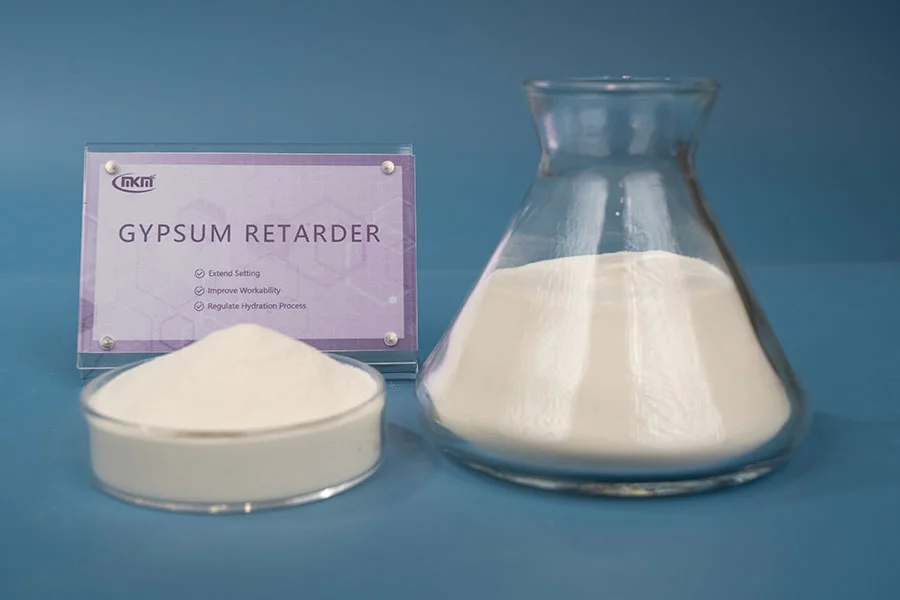
Propiedad | Michem Gypsum Retarder (All Grades) |
Marca | Michem |
Producto | Retardador de yeso |
Componente principal | Complejo de ácido orgánico / Polímero a base de policarboxilato |
Apariencia | White to off-white powder (general); Light yellow powder (grades) |
Grados | GR150, GR200, GR300 (all: bulk density 700±100 g/L, moisture ≤3%) |
Dosis recomendada | 0.1%–0.8% of gypsum weight |
Valor pH (solución 1%) | 5.0-7.0 |
Materia insoluble en agua | ≤0.5% |
Tipos de yeso compatibles | Yeso de construcción, yeso de París, yeso de alta resistencia, anhidrita |
Vida útil | 12 meses (sellado, condiciones secas) |
Embalaje | Bolsa tejida de 25 kg con forro interior de PE; embalaje OEM disponible |
Quality System | ISO 9001:2015 |
Fuente: Especificaciones técnicas oficiales de Michem (michemicals.com).
Target Set Time | Building Gypsum (20°C) | Plaster of Paris (20°C) | High-Strength Gypsum (20°C) | Anhydrite (20°C) |
20 min | 0.10% | 0.08% | 0.15% | 0.05%* |
30 min | 0.15% | 0.12% | 0.20% | 0.08%* |
45 min | 0.22% | 0.18% | 0.30% | 0.15%* |
60 min | 0.28% | 0.22% | 0.40% | 0.20%* |
75 min | 0.35% | 0.28% | 0.48% | 0.25%* |
90 min | 0.42% | 0.34% | 0.58% | 0.30%* |
120 min | 0.55% | 0.44% | 0.75% | 0.40%* |
*Anhydrite may not require retarder at normal temperatures; values shown for hot-weather or large-pour conditions.
Note: Starting dosages for 20°C application. For other temperatures, apply the temperature correction factor. Always validate per ASTM C466.
Application Temperature | Multiply Calculated Dosage By |
5°C | ×0.50 |
10°C | ×0.70 |
15°C | ×0.88 |
20°C | ×1.00 |
25°C | ×1.15 |
30°C | ×1.30 |
35°C | ×1.65 |
40°C | ×2.00 |
Paso | Acción | Detalle |
1 | Calcular la dosis | Use the methodology above (Steps 1–7) |
2 | Mix trial batch | Use exact formulation including all additives; weigh materials precisely |
3 | Measure initial set | Per ASTM C466 (Vicat apparatus) at application temperature |
4 | Compare to target | If within ±15% of target → accept; if outside → adjust and retest |
5 | If set time too short | Increase dosage by 0.05%–0.10%; retest |
6 | If set time too long | Decrease dosage by 0.05%–0.10%; retest |
7 | Document final dosage | Record gypsum source, batch, temperature, and validated dosage for QC reference |
8 | Establish QC range | Set upper/lower dosage limits (±0.05% of validated dosage) per ISO 9001:2015 |
Comprobar | Método | Criterio de aceptación |
Baseline set time (no retarder) | ASTM C466 | Measured and recorded for each gypsum source |
Retarded set time | ASTM C466 | Within ±15% of target |
Set time ratio (final/initial) | ASTM C472 | 1.5–2.5× (consistent hydration) |
Strength verification | ASTM C472 / EN 13279-1 | ≥90% of unretarded control at 28 days |
Batch reproducibility | ISO 9001:2015 sampling | Set time CV ≤15% across batches |
Temperature monitoring | Thermometer at mixing station | Recorded at each batch; dosage adjusted per temperature table |