
In the first 2–6 hours after placement, fresh concrete pavement is vulnerable. As bleed water evaporates from the surface faster than it rises from below, capillary tension builds in the paste phase. When this tensile stress exceeds the very low early-age tensile strength of fresh concrete (typically 0.1–0.3 MPa at 2–4 hours), the surface cracks.
Factors that increase plastic shrinkage cracking risk:
| Fator | Threshold for High Risk |
|---|---|
| Air temperature | > 30 °C |
| Relative humidity | < 50% |
| Wind speed | > 5 m/s |
| Concrete temperature | > 30 °C |
| Evaporation rate | > 1.0 kg/m²/h (ACI 305R) |
These conditions are common across the GCC, South Asia, Africa, and parts of Latin America — the very markets where concrete pavement construction is growing fastest.
After setting, continued moisture loss causes the concrete to shrink. In pavements, this shrinkage is restrained by base friction, producing tensile stresses that can exceed the hardened concrete’s tensile strength and generate regularly spaced transverse cracks.
At pavement joints, impact loads from traffic and infiltration of debris cause edge spalling. Micro-cracks at the joint interface accelerate this deterioration. Over time, water intrusion through these cracks causes sub-base erosion and pumping — the precursor to full pavement failure.
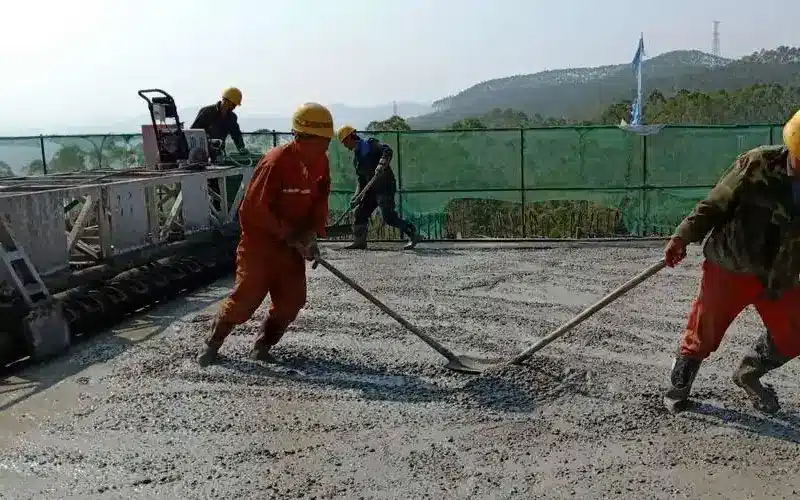
TenaBrix® PP fibers are monofilament micro fibers with a diameter of 30–32 μm — roughly the same diameter as a human hair. At the recommended dosage of 0,6-0,9 kg/m³, a cubic metre of concrete contains hundreds of millions of individual fibers uniformly dispersed throughout the matrix.
When a micro-crack initiates in the plastic concrete, it encounters fibers spanning the crack plane. These fibers bridge the crack, transferring tensile stress across the opening and preventing it from widening. The result: micro-cracks are arrested at widths below 0.1 mm rather than propagating into visible, structurally significant cracks.
The vast fiber network creates a slight “thickening” effect on the fresh concrete bleed water migration, promoting more uniform bleeding. This reduces the formation of bleed channels and weak surface laitance — both of which contribute to surface defects and dusting.
While PP fibers do not provide post-crack structural capacity like steel fibers, they significantly improve the toughness and impact resistance of the concrete surface. Pavement surfaces with PP fibers resist spalling and edge chipping better than plain concrete.
| Propriedade | Especificação |
|---|---|
| Material | 100% polipropileno virgem |
| Tipo | Microfibra de monofilamento |
| Aparência | Branco |
| Diâmetro | 30–32 μm |
| Available lengths | 3 mm, 6 mm, 9 mm, 12 mm, 18 mm, 19 mm |
| Resistência à tração | ≥ 500 MPa |
| Módulo elástico | ≥ 4,500 MPa (4.5 GPa) |
| Alongamento na ruptura | 20–25% |
| Densidade | 0,91 g/cm³ |
| Ponto de fusão | 160 °C |
| Recommended dosage | 0,6-0,9 kg/m³ |
| Certificações | ASTM C1116-03, ASTM D7508, EN 14889-2 |
Different pavement applications call for different fiber lengths:
| Aplicativo | Comprimento recomendado | Rationale |
|---|---|---|
| Highway / road pavement | 12 mm, 18 mm, 19 mm | Longer fibers bridge larger cracks; suitable for thicker slabs (150–300 mm) |
| Sidewalks / footpaths | 6 mm, 9 mm | Shorter fibers disperse easily in thinner slabs (75–100 mm) |
| Industrial hardstanding | 12 mm, 19 mm | Heavy-duty surfaces need maximum crack-bridging capacity |
| Airport apron / taxiway | 19 mm | Thick slabs (200–400 mm) benefit from longest fibers |
| Concrete overlay / whitetopping | 6 mm, 9 mm | Thin overlays (50–100 mm) require short fibers for uniform dispersion |
| Slipform paving | 6 mm, 9 mm | Shorter fibers reduce drag on slipform paver and maintain smooth surface finish |
Rule of thumb: Fiber length should not exceed approximately 1/3 of the slab thickness to ensure uniform dispersion without clumping.
| Dosage Level | Amount (kg/m³) | Aplicativo |
|---|---|---|
| Minimum effective | 0.6 | Low-risk cracking conditions, moderate climate |
| Standard recommended | 0.7–0.8 | General pavement, most climate conditions |
| High-risk conditions | 0.9 | Hot/dry/windy weather, large pours, high-shrinkage mixes |
Based on ring-test and panel-test data (ASTM C1579):
| Dosagem (kg/m³) | Crack Area Reduction (%) | Max Crack Width (mm) |
|---|---|---|
| 0 (control) | 0 | 1.5–3.0 |
| 0.3 | 40–50 | 0.8–1.2 |
| 0.6 | 70–80 | 0.3–0.5 |
| 0.9 | 85–95 | 0.1–0.2 |
| 1.2 | 90–95 | 0.05–0.1 |
Observação: Beyond 0.9 kg/m³, the incremental benefit diminishes rapidly. The optimal cost-performance balance for most pavement applications is 0,6-0,9 kg/m³.
PP fibers slightly reduce the workability of fresh concrete. The fiber network increases apparent viscosity and may reduce slump by 10–25 mm. Do not compensate by adding water — this reduces strength and increases shrinkage. Instead:
| Propriedade | Plain Concrete | PP Fiber Concrete (0.8 kg/m³) | Improvement |
|---|---|---|---|
| Plastic shrinkage crack area | 100% (baseline) | 15–25% | 75–85% reduction |
| Maximum crack width | 1.5–3.0 mm | 0.1–0.5 mm | 80–95% reduction |
| Impact resistance (ACI 544) | 100% (baseline) | 130–150% | 30–50% increase |
| Shatter resistance | Moderado | Alta | Aprimorado |
| Surface spalling resistance | Baseline | Aprimorado | Fewer edge defects |
| Freeze-thaw durability (ASTM C666) | Baseline | Improved 10–20% | Reduced surface scaling |
| Compressive strength | Baseline | ±5% (negligible change) | No adverse effect |
| Flexural strength | Baseline | +0–5% | Slight improvement |
| Criterion | TenaBrix® PP Fiber | Fibra de aço |
|---|---|---|
| Primary function | Plastic shrinkage crack control | Post-crack load capacity (toughness) |
| Dosagem | 0,6-0,9 kg/m³ | 20–40 kg/m³ |
| Cost per m³ of concrete | Baixa | 10–20× higher |
| Risco de corrosão | None (inert polymer) | Possible in aggressive environments |
| Mixing ease | Easy, disperses readily | Requires careful batching |
| Surface finish | Minimal fiber visibility | Fibers may protrude |
| Post-crack performance | Mínimo | Significant (residual flexural strength) |
| Melhor para | Crack prevention, surface durability | Structural toughness, heavy-load pavements |
| Combined use | Can be used with steel fiber for synergistic effect | — |
Recomendação: For most highway, sidewalk, and light-industrial pavement applications, TenaBrix® PP fiber alone provides the best cost-to-benefit ratio. For heavy-duty industrial pavements subject to point loads and impact, a combined PP + steel fiber system delivers both early crack control and long-term toughness — using less steel fiber than a steel-only solution, reducing overall cost.
TenaBrix® PP fibers comply with all of the above standards.
A 4 km service road parallel to a major highway was cast in a GCC country during summer (ambient 38–44 °C, RH 25%, wind 4–6 m/s). The pavement slab was 200 mm thick over a granular base.
Approach:
Results at 28 days:
| Observation | Control Section | PP Fiber Section |
|---|---|---|
| Visible plastic shrinkage cracks | 23 cracks per 100 m | 2 cracks per 100 m |
| Maximum crack width | 2.5 mm | 0.3 mm |
| Joint spalling at construction joints | 4 joints affected | 0 joints affected |
| Surface dusting | Moderado | Mínimo |
| Compressive strength (28 d) | 38 MPa | 37 MPa |
The PP fiber section required no remedial crack filling or surface treatment, while the control section needed epoxy injection at 11 locations before opening to traffic.