Shotcrete is one of the most widely used construction materials for ground support in tunnels, slope stabilization, mining operations, and underground infrastructure. Global tunnel construction spending exceeds $130 billion annually, and the quality of fiber reinforcement directly determines structural safety, maintenance intervals, and overall project lifecycle costs. Choosing the wrong reinforcement system leads to premature cracking, water ingress, corrosion-driven spalling, and — in the worst case — catastrophic lining failure.
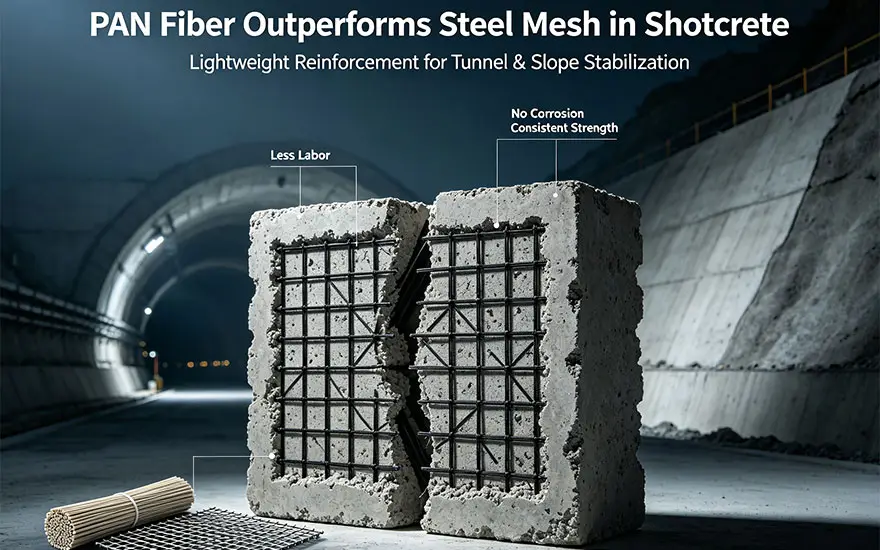
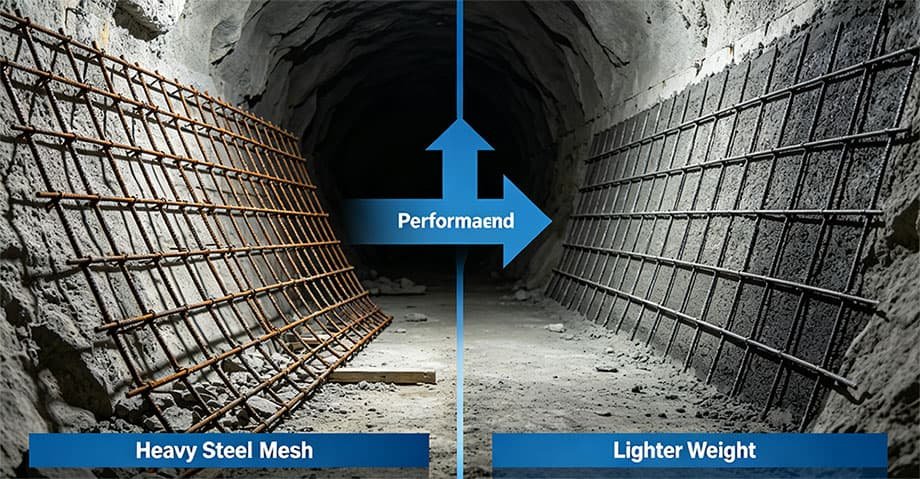
The traditional approach of welded wire mesh reinforcement creates a fundamental problem: mesh is a two-dimensional reinforcement plane that leaves unreinforced zones between layers, requires extensive labor for placement on curved tunnel profiles, and creates a shadow effect during spraying that produces voids behind the reinforcement. Steel fiber was introduced to solve some of these issues, but it brings its own set of problems — high rebound rates that waste 15–30% of material, pump and nozzle wear from abrasive steel filaments, and long-term corrosion risk in aggressive groundwater environments.
PAN fiber from Michem addresses all of these failure modes simultaneously. By providing three-dimensional micro-reinforcement that disperses uniformly through the shotcrete matrix, it eliminates the planar limitations of mesh and the rebound waste of steel fiber. For project owners, consulting engineers, and contractors specifying shotcrete reinforcement in tunnels, slope stabilization, and underground works, the choice of fiber directly impacts construction speed, material cost, structural durability, and — most critically — fire safety performance in the operational phase.
Fibra PAN integration begins at batching, where its low density (~1.18 g/cm³) and filament geometry enable uniform dispersion without the balling problems that plague steel fibers. The aspect ratio — 200:1 to 1,200:1 depending on length — balances dispersion quality with mechanical anchorage in the cement matrix. During pumping, PAN filaments partially align with flow direction, reducing pipe friction versus rigid steel fibers that bridge across hose cross-sections and cause blockages. The flexible filaments navigate high-velocity turbulent flow without the abrasive pump wear steel fiber inflicts on rotors, stators, and delivery pipes.
At the nozzle, the physics of impact fundamentally distinguish PAN from steel fiber. Steel fiber, with its high density (7.85 g/cm³) and rigidity, carries substantial kinetic energy into the impact zone at 30–40 m/s nozzle velocity. A large fraction of that energy returns elastically — the fiber bounces rather than embedding — producing the 15–30% rebound rate characteristic of steel fiber shotcrete. PAN fiber filaments, weighing fractions of a milligram each, carry orders of magnitude less kinetic energy. Combined with filament flexibility that allows conformance to the fresh shotcrete surface texture, embedment probability exceeds 95%. The under 5% rebound rate yields direct savings in material cost, cleanup labor, and jobsite waste disposal.
Tunnel fire safety is governed by standards such as the Rijkswaterstaat (RWS) fire curve, specifying rapid temperature rise to 1,200°C within minutes, sustained up to two hours. Under these conditions, conventional reinforcement materials face distinct failure modes:
Propiedad | Fibra PAN (Michem) | Fibra de acero | Fibra de PP (TenaBrix®) |
Density (g/cm³) | ~1.18 | 7.85 | ~0.91 |
Resistencia a la tracción (MPa) | ≥500 (HM: ≥800) | 800–1,200 | ≥500 |
Elastic Modulus (MPa) | ≥4,000 (HM: ≥8,000) | 200,000 | 3,500–4,000 |
Rebound Rate | <5% | 15–30% | <5% |
Resistencia al calor | ≥200 °C | ~1,400°C (melts) | 160°C (melts) |
Corrosion Resistance | Inert (alkali-resistant) | Prone to corrosion | Inert |
Pump Wear | Bajo | Alta | Bajo |
3D Distribution | Excelente | Good (with care) | Excelente |
Dosificación (kg/m³) | 0.9–1.8 | 25–40 | 0.9–1.8 |
The comparison reveals that PAN fiber occupies a unique position: it matches PP fiber’s ease of handling and low rebound while dramatically surpassing its thermal performance, and it approaches steel fiber’s mechanical contribution while eliminating corrosion risk and installation complexity. For tunnel shotcrete applications where fire safety is non-negotiable, PAN fiber provides the best balance of mechanical performance, durability, and passive fire protection.
Underground shotcrete linings face groundwater containing sulfates, chlorides, and variable pH. Steel corrodes through electrochemical mechanisms, with corrosion products occupying 2–6× the original volume — generating internal pressure that spalls the concrete cover. PAN fiber, as a chemically inert polymer, is immune to electrochemical corrosion. Michem’s alkali-resistant grade features a proprietary coating resisting the high-pH cement pore solution (pH 12.5–13.5), preserving fiber properties over the structure’s design life.
PAN Fiber — Michem Brand
Parámetro | Especificación |
Material | Polyacrylonitrile (PAN) |
Diámetro | 14–18 μm |
Longitudes disponibles | 3 mm, 6 mm, 12 mm, 18 mm |
Resistencia a la tracción | ≥500 MPa |
Módulo elástico | ≥4.000 MPa |
Densidad | ~1,18 g/cm³ |
Resistencia al calor | ≥200 °C |
Resistencia a los álcalis | High (coated grade: ≥95% strength retention) |
Certificaciones | ASTM C1116, EN 14889-2, ISO 9001:2015, GB/T 21120 |
Three Product Grades:
Grado | Resistencia a la tracción | Característica principal |
Fibra PAN de alto módulo | ≥800 MPa | Maximum crack control for structural shotcrete |
Fibra PAN resistente a los álcalis | ≥750 MPa | Coated surface for wet tunnel & groundwater exposure |
Atajo de fibra PAN | ≥700 MPa | Optimized for thin-layer shotcrete and repair mortars |
PP Fiber (TenaBrix®) — Reference Only
Parámetro | Especificación |
Diámetro | 30–32 μm |
Resistencia a la tracción | ≥500 MPa |
Punto de fusión | 160 °C |
Aplicación | General shotcrete (non-fire-rated) |
The integration of PAN fiber into a shotcrete mix requires minimal adjustment to standard mix designs. The fiber is added at the batching stage — either into the dry mix before the mixer or into the wet mix at the ready-mix plant. Unlike steel fiber, no specialized dosing equipment is required. Standard practice is to add PAN fiber as the last component after aggregates and cementitious materials have been combined, mixing for an additional 30–60 seconds to achieve uniform dispersion.
Recommended Dosage by Application:
Aplicación | PAN Fiber Type | Longitud recomendada | Dosificación (kg/m³) |
Tunnel primary lining | De alto módulo | 12–18 mm | 1.2–1.8 |
Tunnel secondary lining (fire-rated) | Resistente a los álcalis | 12 mm | 1.0–1.5 |
Slope stabilization | De alto módulo | 6–12 mm | 0.9–1.2 |
Mining shotcrete | De alto módulo | 12–18 mm | 1.2–1.8 |
Wet tunnel repairs | Resistente a los álcalis | 6–12 mm | 1.0–1.5 |
Thin-layer repair mortar | Atajo | 3-6 mm | 0.6–0.9 |
PAN fiber shotcrete should be tested for fiber content using the wash-out test per EN 14488-7: a fresh sample is washed through a sieve to separate and weigh fiber content, verifying actual dosage against specification (±10% tolerance). Slump and workability tests should confirm that fiber addition has not adversely affected rheology — at 0.9–1.8 kg/m³, the slump reduction is typically under 10 mm. If adjustment is needed, a superplasticizer at 0.2–0.5% by weight of cementitious material suffices.
Standard dry-mix or wet-mix equipment is used without modification. Maintain nozzle distance at 1.0–1.5 m, held perpendicular to the receiving surface. Overhead layer thickness should not exceed 50–75 mm per pass to prevent sloughing. The low rebound rate substantially reduces overspray cleanup — critical in tunnels where rebound accumulation disrupts subsequent operations.
Standard shotcrete curing practices apply: wet curing for a minimum of 7 days, or application of a curing membrane immediately after final set. PAN fiber’s contribution to plastic shrinkage crack control is most effective during the first 24 hours when the concrete matrix has not yet developed significant tensile strength. Maintaining adequate curing ensures that the cement matrix achieves its design strength, allowing the PAN fiber to function as a crack-bridging reinforcement system throughout the structure’s service life.